DAVID HEY 1946 -2018
Sadly David passed away on March 17, 2018 after a short illness.
This incredible website is David's legacy, not just to all of you who visit, but to us, his daughters, too. We are delighted to say that it has been preserved for present and future generations by the British Library who have added it to their web archive, ensuring it will always be accessible via this link:
https://www.webarchive.org.uk/wayback/archive/*/http://www.davidheyscollection.com/
Meanwhile we shall continue to keep our Dad’s site open here for a further year. Please make a note of the link above so that you may continue to enjoy it after this time.
Thank you for your interest in Dad’s work and may we wish you continued enjoyment of David Hey’s Collection.
As a small boy in the 1950s I'd listen to old folk chin-wagging over back yard walls, moaning in general about life's ups and downs, and wondering where all the years had gone. I hadn't a clue what they were talking about, but now I'm their age, I'm just the same…the time seems to have flown by.
Of course, everyone reaches an age when they notice a conspicuous slowing down in energy levels, shopping bags seem a lot heavier and climbing stairs become more difficult. But rather than caving in to the ageing process it's plainly helpful to adopt a more positive frame of mind; indeed one of the best ways of escaping this humdrum world is by indulging in a spot of nostalgia for the old days, which, for my generation of ex-train spotters will revive some truly remarkable memories of our childhood spotting trips. However not everyone is interested in our 'gung-ho' spotting adventures from sixty-odd years ago. Perhaps they think we're making it all up?
Whatever the reason, why is it that young people today regard OAPs as having nothing to say that's worth listening to? They've simply written us off as a bunch of grumpy old loonies, constantly moaning about declining standards, and because 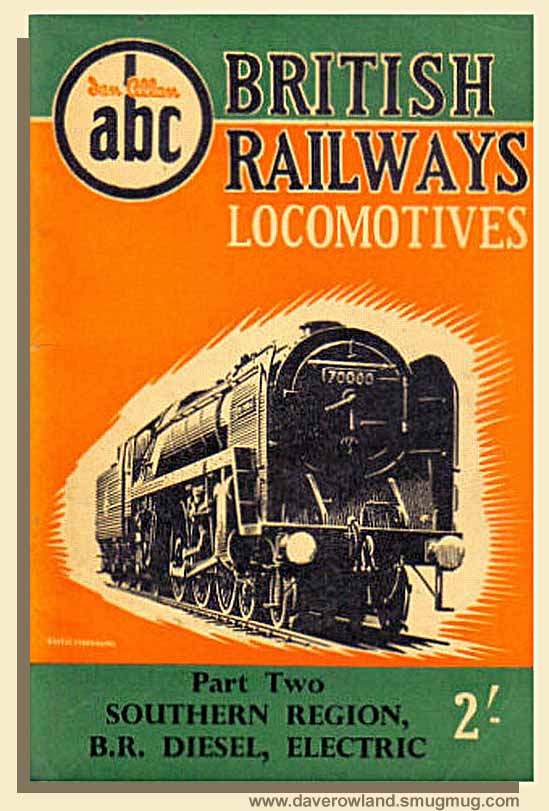 we refuse to pander to liberal opinion we end up being marginalised, almost criminalised - a slight exaggeration, perhaps, but it'll do for starters.
I'm talking about the calamitous affects of mass immigration, the chronic abuse of our foreign aid budget, the grubby world of politics and dodgy Eurocrats who make up the rules to suit themselves. In short, this crazy world is getting madder by the day and Britain is not the same country we were born and voted for all our lives...oh dear, don't get me going!
Okay, I'll stop there before this turns into a rant…after all this introduction is intended to be a cheery stroll down memory lane; a website built especially for train spotters, all of whom are like old friends dropping in to wallow in some old-fashioned nostalgia - it is them, more than anyone, that makes it such a joy to work on…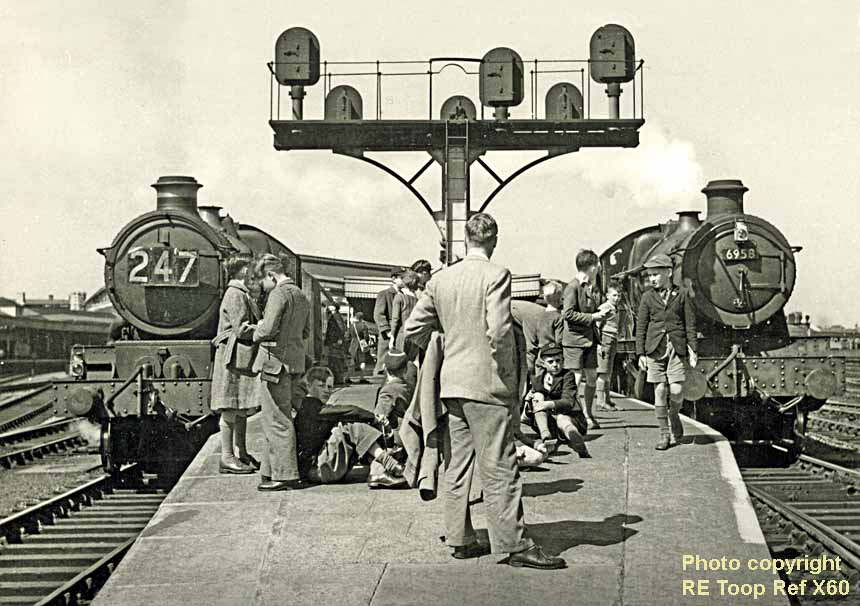
(Above) Doing what countless thousands of schoolboys loved best on a sunny weekend in the 1950s; this shot by RE Toop is a favourite photo from steam days when train spotting was the national hobby for 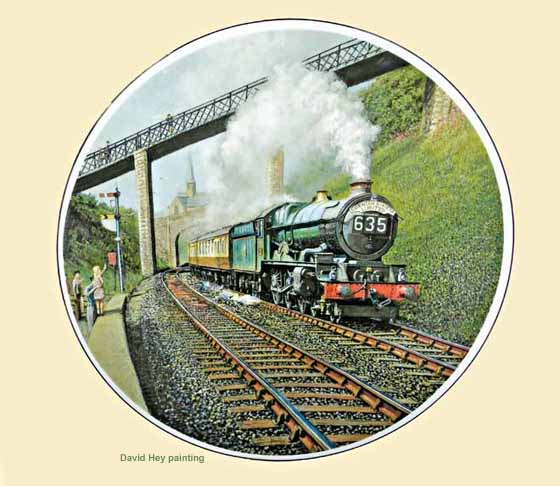 youngsters and large groups like this could be found congregating at every major railway station. This group of boys in blazers and schoolcaps are flanked by 'Hall' class No 6958 Oxburgh Hall and 'Castle' class 7029 Clun Castle at the west end of Bristol Temple Meads station on Saturday 8th May 1954.
(Below) Now in our Seventies, our eyesight and hearing might not be what it used to be, but the memories we have of train spotting are still intact, and so too is our weakness for seeing the funny side of growing old. I must spend the best part of the day sending myself up…and why not? A sense of humour helps to cope with the daily struggle of getting a pair of shoes on the correct feet every morning or remembering to zip up my flies before popping out to the shops. Okay, perhaps a miserablist streak of humour isn't everyone's cup of tea, but a bit of clowning around is a good way of deflecting the sniggering cynicism being meted out by today's stony-faced hoi-polloi, not that I care what they think about our hobby - I don't. In this shot below, a couple of young spotters are awaiting their next 'cop' while a meditative teenager contemplates Britain's balance of payments deficit and the driver of 'Jinty' 0-6-0T has a fag break, doubtless looking forward to the end of his shift and a pint at his local BRSA Club.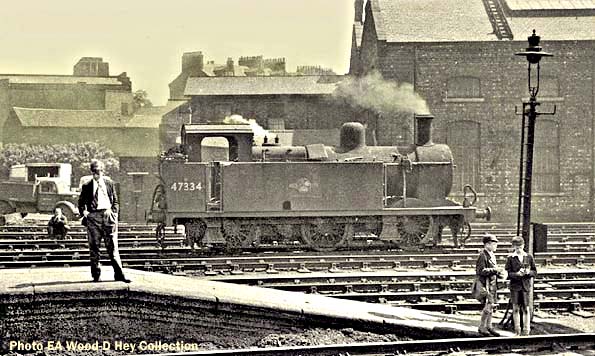
 A warm welcome to the new Second Edition of the collection, a website full of memories from a gentler, more innocent age when the post-war baby-boom was at its height and kids climbed trees, played hopscotch in the street and rode bikes without brakes, all of which is a far cry from today's mamby-pamby society. Life back then was something of a 'Boy's Own' adventure, if you like...but how time flies!
Fast-forward 50-odd years and the ageing process does have its advantages - it gives us a chance to draw on feelings that we were unable to express as small boys.
That's why this website is pitched in a light-hearted fashion. After all, the hobby cuts no ice in today's hard-nosed society and this is especially the case at the parties I'm invited, where the people I meet are constantly looking over my shoulder in case someone more interesting enters the room. Their behavioural tic becomes more frantic when I do my favourite party trick, a tongue-twister...it works best if you pinch your nose and speak in a high-pitched train announcer's voice; it adds pathos to the drama!
'The train now standing at platform four is the five o' four for Forfar, calling at Fife. The first four coaches are for Forfar...the far five for Fife. The first four reach Forfar at four fifty-four and the far five at Fife at five forty-five!'
Okay, you're probably thinking there's a village missing an idiot somewhere so I'll stop larking around. After all, there is a serious side to this site too. It is the growing sense that if we lose sight of our past then we may as well say goodbye to the future.
For many spotters the end of steam overshadowed everything, but locking away one's feelings will not dispose of them, rather it evokes a lot more feelings besides. Once you start unearthing childhood memories long lost in the mists of time a much bigger story starts to unfold; you begin to develop an extraordinary affection for old red telephone boxes, Dinky Toys, Hornby Dublo trains, Vespa scooters, frog-eyed Sprites, old bangers with running boards and starting handles - even women PCs in stockings and suspenders. Indeed much of what 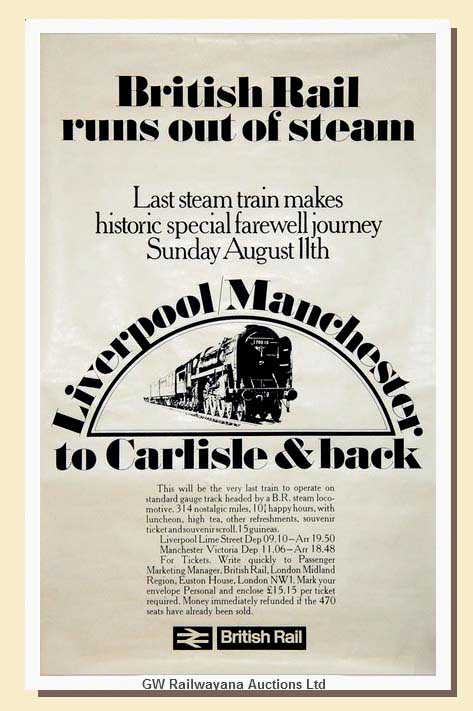 has disappeared during the past fifty years means something special to someone in one form or other, especially BR steam in everyday service.
Today countless thousands of ex-spotters still bear the emotional scars of abandoning their allegiance to steam during the 1960s. Many abstained from the hobby as a matter of principle, others in reluctant surrender, but whatever the reason the overall feeling was that as steam had outlived its usefulness, then so had our interest in trains - a view in which we managed to persist until the bitter finale came in August 1968, and just five steam locomotives were left: 3 Black 5s Nos 44781, 44871, 45110; a solitary 8F No 48448 and the last working 'Britannia' No 70013 Oliver Cromwell.
Sadly, after the '15 Guinea Special' ran on August 11th 1968 (costing over £216 in today's money) it was all over and train spotting would never be the same again. The huge crowds gathered by the lineside to watch BR's last steam-hauled train was quite extraordinary; indeed when you start to delve into the psyche of the spotting fraternity it is difficult to differentiate between out-and-out dedication and mental illness...
...this reminds me of the tale about a hard-core enthusiast who bought two tickets for the '15 Guinea 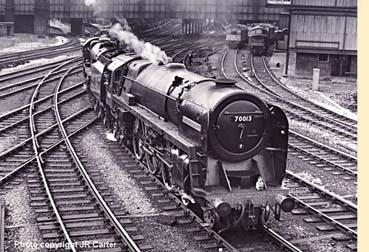 Special'. As he settled into his seat by the window, another man asked if anyone was sitting in the seat opposite him.
'No', he replied, 'the seat is empty….'
'Really!' said the man surprised, 'Who in their right mind would buy a 15 guinea ticket and not use it?'
'Well, actually the seat belongs to me. My wife was meant to be here, but she passed away.'
'Oh, I'm sorry to hear that...I guess you couldn't find someone else, such as a friend or relative to take the seat?'
'No, they're all at the funeral,' he replied.
THE PSYCHE OF A TRAIN SPOTTER
Watching small children playing with toys can reveal a wealth of information about a child's development and the way gender stereotyping is established early on in infancy. Inherent in every girl is a passion for playing with dolls and clip-clopping around the house in mum's high-heeled shoes, whereas small boys 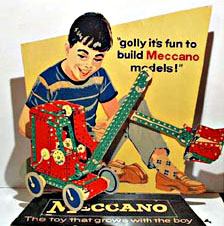 have an unashamed passion for big machines - and the bigger, noisier and dirtier the better!
If I had to run an appraising eye over the big machines I recall as a child - cranes, tipper trucks and diggers; even double-decker buses and trams - then nothing could stimulate a rash of goose-pimples in quite the same way as the sight and sound of a hard-working steam locomotive; the everyday spectacle of BR steam left an indelible impression on 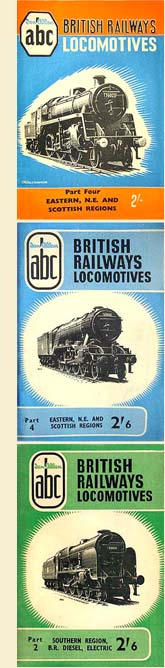 countless thousands of youngsters and not surprisingly train spotting became the national hobby for boys.
The fact is all children like to form strong emotional bonds at a very early age. The need for bonding comes from the desire for social approval and a sense of fitting in with the crowd, either by joining a gang or becoming a member of a club or team.
The same requisite exists in today's digital age, except youngsters today interact in the anonymity of cyberspace by sending endless streams of tweets, emails and texts - none of which comes close to real human contact. If you ask me, a mobile phone is the technological equivalent of a spoiled brat constantly demanding attention. I suppose the same can be said for running a busy railway website, I am constantly at its beck and call.
Of course, back in the less-worldly 1950s the world was a very different place. With no computer games and mobile phones to distract our sensibilities, the kids liberated their youthful exuberance by knocking on one another's doors to rally their mates into a marathon game of hopscotch, football or cricket in the street. And the fact that it involved old-fashioned rough and tumble gave us an even closer connection. In short, there is no substitute for face-to-face interaction.
In fact it doesn't seem all that long ago that boys were encouraged to join a local community group such as a Cub Pack, Scout Group and Youth Club, even a national organisation like the Youth Hostel Association - and being a committed train spotter, the Ian Allan Locospotters' Club was a big draw. All had an important role to play in a boy's social development.
Of course, finding a well-organised group is all fine and dandy, but if you scratch the itchy veneer off a cocky teenager (who thinks he knows it all) then there's always the danger of falling-in with the wrong crowd, say a marauding gang of reprobates just itching for a fight and trouble is never far away; indeed there is a lot of truth in the saying 'strength in numbers', for a gang can descend into a mob-rule mentality at the blink of an eye, and often for no good reason. And because no one takes responsibility for their actions, it allows youngsters to 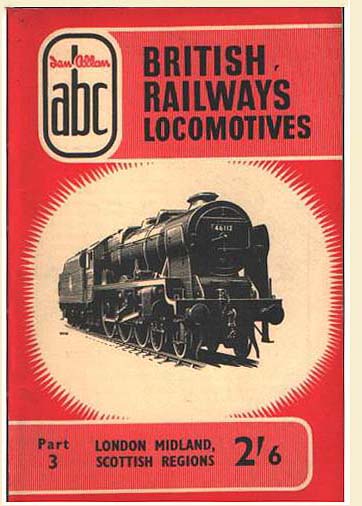 behave in ways that they'd normally never do on their own - think school bullies, flying pickets, football hooligans, even Internet trolls and you'll get my drift.
But why am I telling you all this? Well, train spotting was a whole new ballgame! Okay, we had strength in numbers but I never saw any violence or rivalry; perhaps our behaviour was boisterous at times, but to run away with the notion that spotters were a bunch of rabble-rousing tearaways is way off the mark. The majority of boys I met were loyal, trustworthy, and committed to a single cause, and because we shared a common interest in trains, there was a wonderful sense of belonging to a club that excluded no one from joining..
(Below) Widely known in train spotting circles was our susceptibility to a condition described by analysts as 'unconscious suggestion' - more commonly known as mass hysteria, a classic example being the outpouring of emotion at stations along the East Coast Main Line when the Class A4 Pacifics dominated the Anglo-Scottish expresses. On hearing a Class A4 'Streak's' tri-tone whistle in the distance the interaction among spotters was immediate; a chain reaction of high-octane excitement. We simply couldn't help ourselves; we just got swept along by the raw emotion of it all…In the harsh winter of 1962, Class A4 60028 Walter K Whigham speeds south through Hitchin whilst a Brush Type 2 D5653 awaits departure on a local train.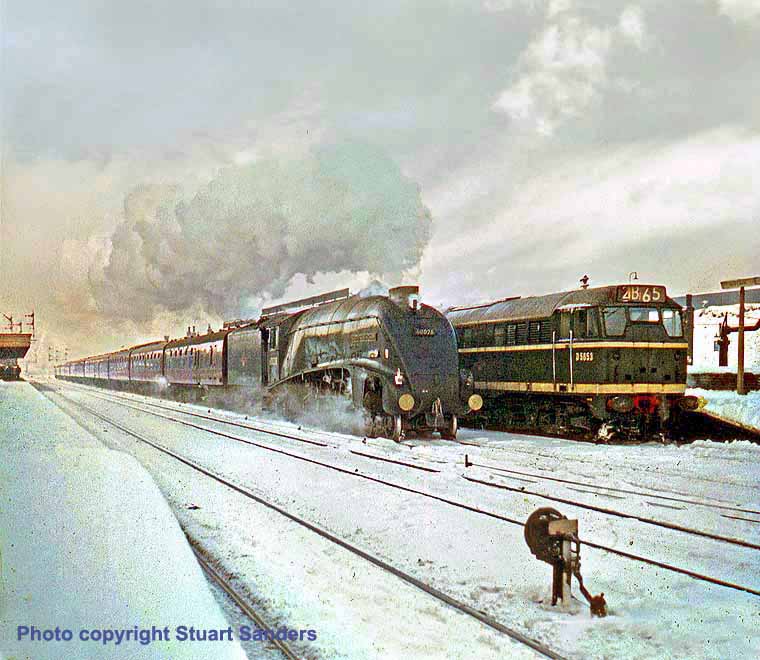
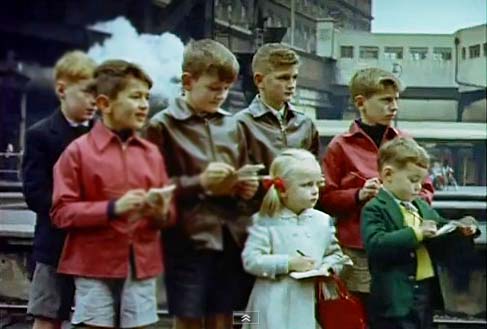
(Above) With notebooks and pencils at the ready, here is an orderly group of train spotters. No, they're not! They are a 'spick and span' version of how the media envisage us! Well, at the risk of sounding sexist I can't imagine the little girl's handbag is chockful with Ian Allan abc books and jam butties! And just look at Lord Snooty on the right...he's straight out of 'Beano' comic. Not a Bash Street kid in sight! This well-mannered group are featured in a promotional film: 'British Locomotives -1959 Steam Trains, Diesel Trains, Electric Trains' by Greenpark Productions in association with the Film Production Guild. You'll see shades of the famous 'Elizabethan' film in the opening shot of an EE Co Type 4 D208 at speed! Click here to watch this enjoyable 20-minute film uploaded by 'wdtvlive42' on 'Youtube'.
A BIG THANK YOU TO EVERYONE FOR CONTRIBUTING TO THE SITE
Not long ago I bumped into an old spotting chum called Bonzo, a somewhat bumptious character I hadn't seen in years; in many ways it should've been a joyous meeting, until I discovered he was still the 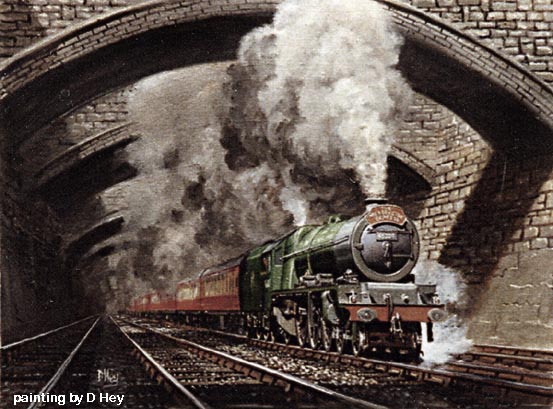 same self-opinionated prat I remember from childhood...not everyone mellows with age.
With hindsight I was a fool for giving way to him as a kid in the Fifties, but being two years his junior made a lot of difference at that age.
However fast-forward to the present day and the two-year age gap means diddly-squat. Not wanting to put too finer point on it, once you get past the 'Big Six-0' and your Seventieth has come and gone, you become acutely aware of your own mortality and the old cliché 'life's too short' carries a lot more clout in the autumnal years of your life. Not that I'm complaining, I thought I'd be pushing up daises by now, so I'm grateful I've got this far.
However, had anyone asked me ten years ago what my plans were for retirement, the last thing on my mind would be running a railway website, but here I am at the controls of an imaginary time machine taking endless trips 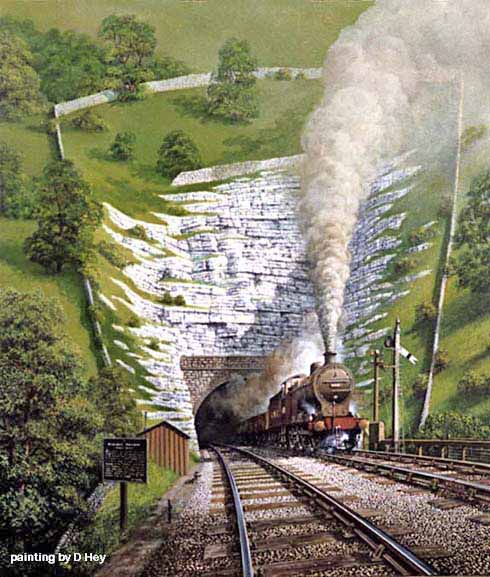 back to childhood days and hopefully providing a platform for anyone else willing to share their spotting memories on the web with others.
Since then the site has just grown and grown, though I couldn't have possibly done it on my own; it's all thanks to dozens of writers and photographers - kindred spirits each and every one - who have dug out their prized negatives, prints and slides for publication on the Internet.
Above all else, they've abandoned the old-fashioned notion that publishing their photos on the web will somehow reduce the currency of their work…it doesn't! The Internet provides a perfect showcase for anyone genuinely driven to give something back to the hobby; in fact everyone has willingly contributed to this project for its own sake with no prospect of financial gain, just the satisfaction of creation...rare qualities indeed in a world obsessed with money and cheap fame...
(Below) Following a decade-long £4.2m refurbishment, the most famous steam locomotive in the world returned to the main line in February 2016. Class A3 60103 Flying Scotsman made its inaugural run from London to York in a blaze of publicity to mark the start of its UK summer tour, however due to the high number of over-zealous steam fans (and the general public) trespassing on running lines, Network Rail have been forced to issue a warning HERE in a bid to reduce the risk of personal injury and disruptions to scheduled rail services. The upshot is, a decision has now been taken not to release the exact timings of trains hauled by 'Flying Scotsman' in advance. Here 60103 'sneaks' through Marsden with a BR Mk1 support coach bound for Crewe Heritage Centre on Tuesday 7th June 2016; the trip was posted simply as a rolling stock movement..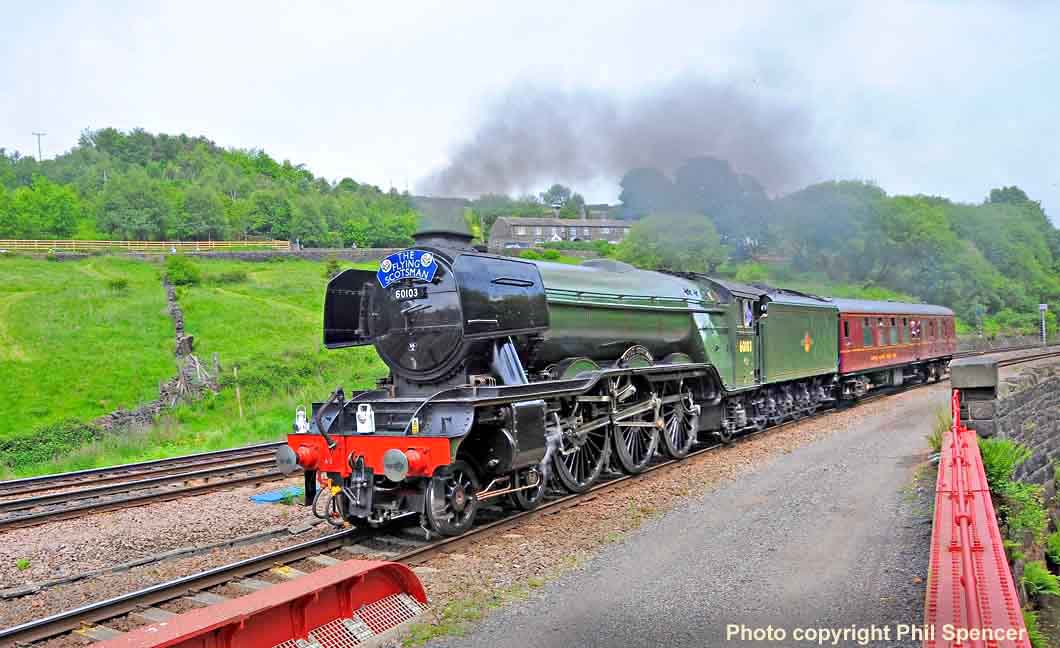
NEW TO THE INTERNET? HERE'S A FEW TIPS FOR FIRST-TIME VISITORS...
A warm welcome to the growing band of 'Silver Surfers' new to the Internet. You're never too old to learn. Harking back to the old days before the World Wide Web (www) was launched in 1989, there was nothing I  liked better than browsing through the pages of railway magazines…old issues of 'Trains Illustrated' and 'Railway Magazine' that I've kept in the bottom of my wardrobe for donkey's years.
Odd then that it took me so long to surf the largest railway archive in the world on the Internet. When I started with a computer back in 2007 I found the 'drag and click mouse' jargon a bit baffling at first, but once I got going it was great to log on and search through the thousands of railway sites.
Trouble is, surfing the 'communications super highway' is a daunting task unless you know what you're doing. Over the years, the World Wide Web has become a victim of 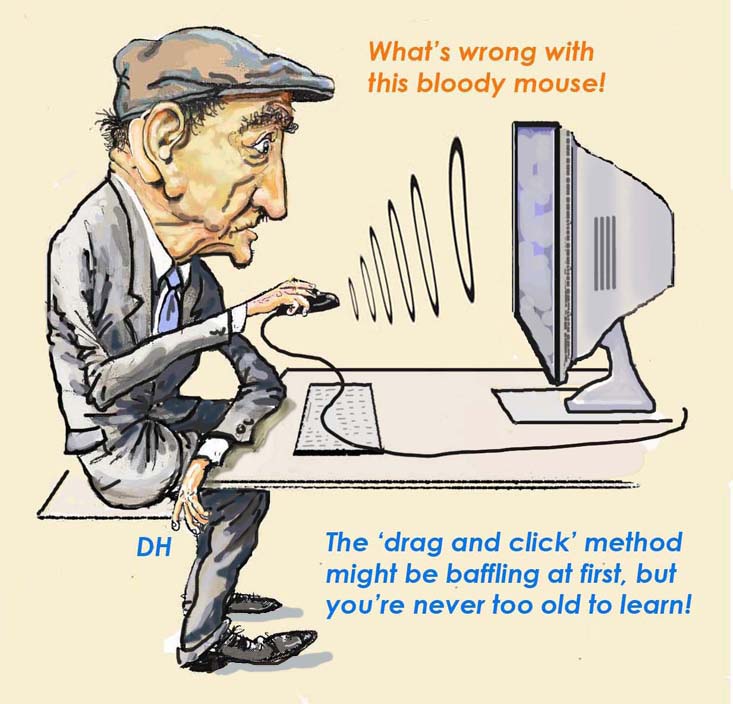 its own success, and the information overload - the sheer volume of material it contains - can take a lot of digesting.
However, the World Wide Web is a fantastic communications tool that allows people from all over the world to keep in touch via the miracle of electronic mail; it provides a wonderful opportunity to meet some really interesting people online…I say meet, you don't actually meet anyone in person, of course, we exist only in one another's hermitically-sealed world of cyberspace and simply exchange greetings on a keyboard.
Indeed there is something liberating about being online, particularly for the elderly whose mental agility might be impaired by advancing years. As you get older the mind can play the daftest tricks…it does with me; very often I'll be in the middle of a deep meaningful conversation and my mind is like a waste paper bin overflowing with unfinished sentences because I've forgotten a particular name or word! 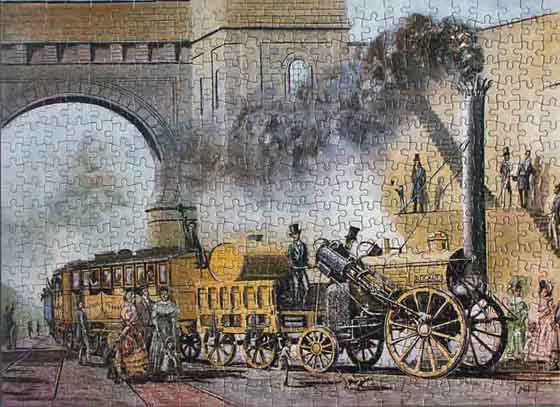 In the most severe cases this missing word may take days, even weeks before I can retrieve it, but by then it's too late - I have no use for a word like 'Steam Cock' when I'm queuing in a supermarket.
However, the inability to remember what I am about to say next never happens to me online, but even if it did I still have the aid of a spell checker and thesaurus. Plus the 'save-draft' option is very useful as it allows me to take as long as I like to communicate via an email without lulling the recipient into a comatose state because my mind is a total blank.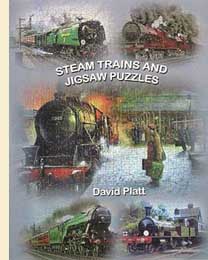 Mind you I rarely get the chance to meet up personally, as David Platt and I did recently at Birch Services on the M62 - just a pair of old geezers gassing about trains, a subject very close to both our hearts. Between infuriating long pauses, I was thinking about something quite different at the time; I was trying to remember if I'd left the immersion heater on at home - it turns out that David is something of an expert on railway jigsaw puzzles and has created a new website dedicated to the subject - click here for link. The site includes an illustration of a painting I did (left) for the Rocket 150 Celebrations at Rainhill in 1980, which was reproduced as a jigsaw puzzle along with 'Lion at Rainhill' (below). David is also the author of a book - 'Steam Trains and Jigsaw Puzzles' (right).
However, a word of caution when surfing the World Wide Web…it's simply a matter of using your noggin; indeed you're probably an open-minded sort of person in the normal way, but really - would you want to invite every Tom, Dick and Harry to access your bank account and rummage through your private life? No, me neither. There are countless websites that deal with internet security…it's worth taking a peek at this link below just to be on the safe side...
https://www.getsafeonline.org/protecting-your-computer/safe-internet-use/
Also there has been a lot of bad press lately concerning the harmful effects of the Internet, such as the rise in cyber crime and bullying trolls, and in particular there is a lot of criticism about the way the Internet provides access to evil child pornography and other online extremism.
This was brought to a head recently when Sir James Munby, the country's most senior family law judge, commented - 'The Internet allows anyone, effectively at the click of a mouse, to publish whatever they wish. The consequence is that the Internet is awash with material couched in the most exaggerated, extreme, offensive and often defamatory terms, much of which has only tenuous connection with objectively verifiable truth.'
Strong words indeed, but he does have a point.
However we must not forget that there is also a fantastic amount of good things to be found on the Internet. It gives everyone super-quick access to every subject under the sun, which, for a serious student seeking the definitive answer to even the fuzziest question is a real boon.
Of course, this new-fangled digital thingamajig called the Internet will look completely alien to the first-time silver surfers, who've probably spent their whole lives traipsing back and forth to and from the public library scouring for books and think the Internet is far too complicated for them to master.
Oh, but master it they will. It's simply a matter of getting your head around all the nonsensical jargon...for example, if we turn the clock back to the days before we had computers, a 'hard drive' was a long trip on the road; 'memory' was something you lost with age; a web was something that spiders spun and a 3½" floppy - well, that's nobody's business but your own!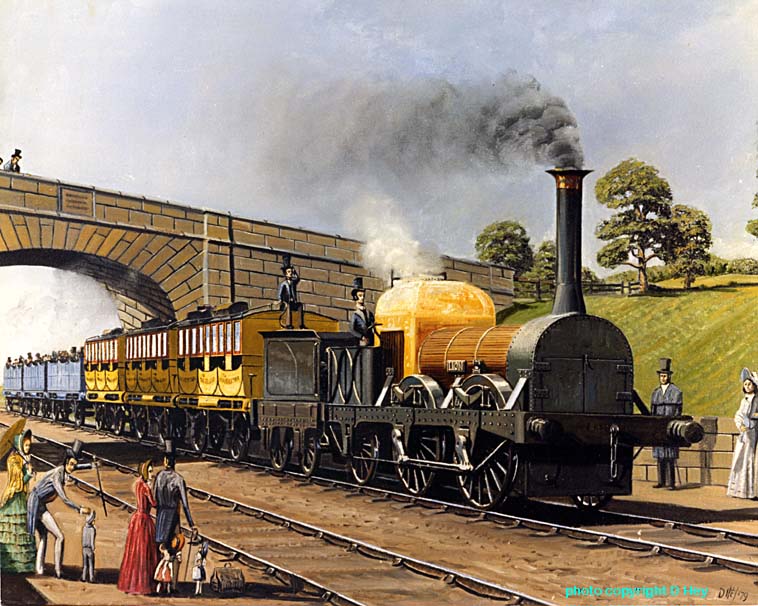
ARCHIVING THE WEBSITE
Having started this website in 2008, by the end of 2015 I hit a BIG snag! The site had just grown and grown over the years and it was now full to bursting, but since I had used up Mr Site's maximum permitted one hundred pages I was stuck in the  middle with no place to turn.
Then like manna from heaven, at the beginning of 2016 the British Library decided to harvest the contents of the site for archiving in the UK Web Archive. It was the perfect solution to my problem because what makes the UK Web Archive so special is that many of the sites they have archived contain information no longer available because the actual 'live' site has been taken down and no longer exists. In which case the UK Web Archive holds the only copy that remains available for future generations.
In the final analysis since this website is now being archived by the British Library it gives me the chance to free-up space and make wholesale changes...there is a huge  amount of material to be added!
However, no content from this site will be deleted until such time as I am sure it has been fully harvested. Please note, the archived version will not appear in a search engine therefore links will be provided where appropriate.
Please also note - websites usually go off-line whilst maintenance work is carried out or other changes are beingmade, but in view of the size of the task (it will take several months) it was decided to remain online - after all, there's nothing to hide. I just hope the changes do not spoil your viewing.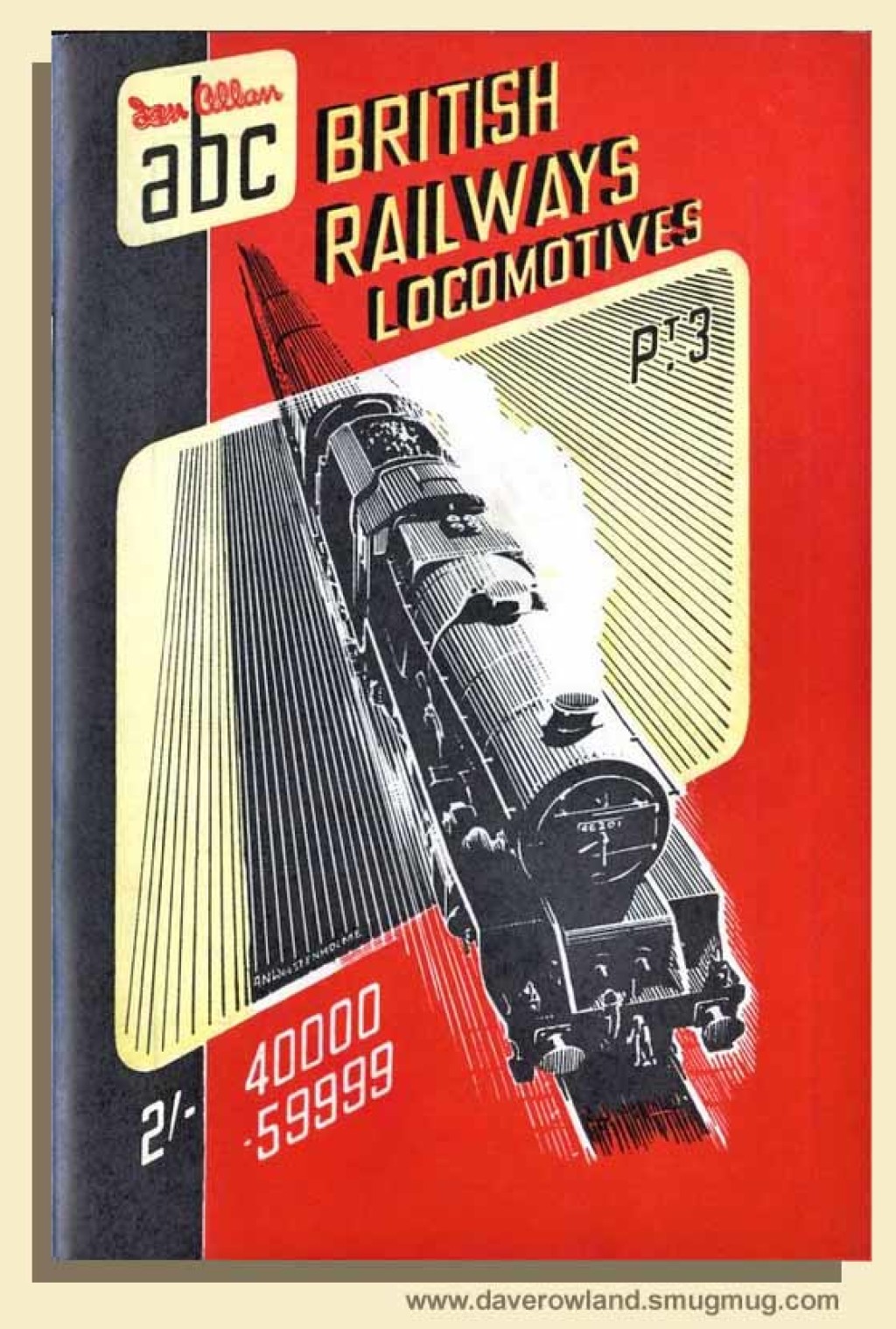
(Above-Below) Memories of Ian Allan ABCs - Click HERE to visit Dave Rowland's 'Famous Ian Allan ABC Books'…a lovely website and beautifully illustrated, featuring the covers of every conceivable spotters' book published…the site is a veritable trip down memory lane. (Below) It will soon be over! Memories of the final months of BR steam, by which time only one member of the Class 7MT 'Britannia' 4-6-2s remained in traffic. Here a group of enthusiasts both young and old gather around No 70013 Oliver Cromwell pausing at Rochdale station with the GC Enterprises 'NW Circular Tour' on 28 April 1968.
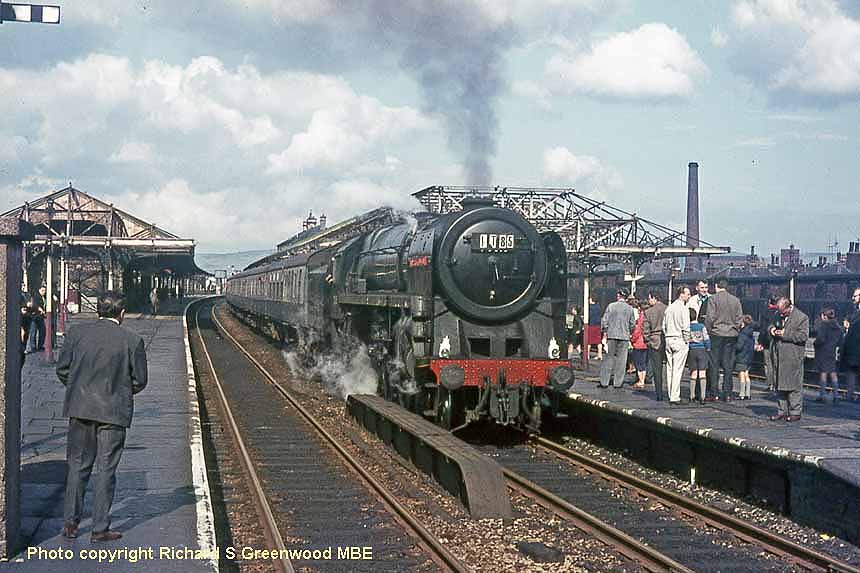
CHANGING ATTITUDES...
Those were the days my friend,
We thought they'd never end,
We'd sing and dance forever and a day,
We'd live the life we choose,
We'd fight and never lose,
Those were the days, oh yes those were the days.
The lyrics of Mary Hopkins's 1968 hit song 'Those Were The Days' will ring a bell with my generation…the Swinging Sixties was the best time ever to be a teenager…but as the saying goes, all good things come to an end, as it did for me back in the mid-Sixties..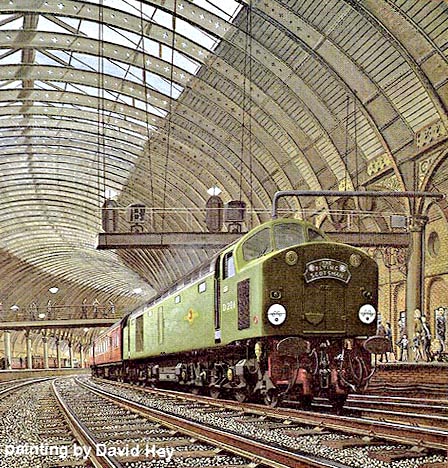 Oh dear, there isn't a day goes by that I haven't kicked myself for deserting the hobby when I did; but in the 1960s I had reached that difficult age when a pubescent boy matures into a teenager very quickly, the girls even quicker; heads begin to turn, eyes start to roam; everyone is sizing one another up.
It was a far cry from my 1st year at school when I cruelly teased a group of gangling girls about their 'stick insect' legs; it was a horrible thing to do and I'm ashamed of myself now. But then just three years later by some miracle of nature, the girls turned the tables in rather a dramatic fashion when they morphed into the sexiest creatures on two legs in the school's fourth year…well you notice these things at that age, don't you?
Indeed you do. Once an adolescent is smitten by testosterone and every other hormonal imbalances his journey into adulthood is fraught with problems.
For starters, a major flaw in a teenager's genetic makeup is a natural deficiency in personal hygiene; a soap and water allergy that goes back years. He 'pongs' to high heaven and a hot bath is desperately needed to neutralise bad odours; a process not 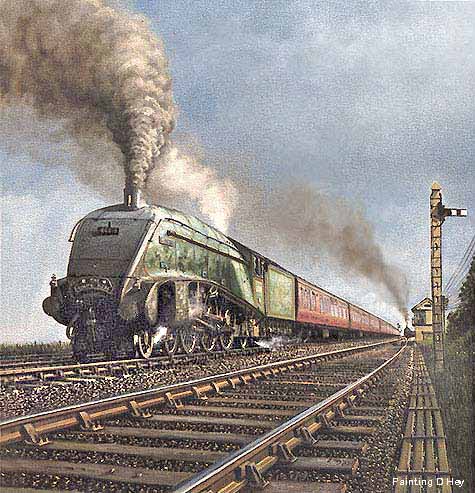 dissimilar to fumigating a blocked sewer. But once his ordeal is over he'll cheerfully slick back his hair with a dollop of dad's Brylcreem and skedaddle off in hot pursuit of a bit of crumpet in the local park.
Alas, no sooner had these carnal urges kicked-in and the unthinkable was about to happen next; my commitment to train spotting went downhill fast. It began the mid-1960s, by which time Mary Quant's mini skirt was at its height and the rank and file of BR steam had sunk to a new low. Things got so bad that my decision to desert the spotting brotherhood became an easy choice to make; I hung up my anorak without any rational thinking or sensible weaning-off period. Perhaps it's because I'd picked up on the snide comments being bandied around by the girls in the school playground. They were saying that train spotters were a bunch of sissy kids!
Oh puh-leeze!
Okay, perhaps my comeuppance was long overdue after dishing out 'stick insect' taunts all those years ago, but to question a boy's macho credentials at such a sensitive age was equally as detestable. Back in the dog-eat-dog world of a 1960's childhood, long before politically correct demands were placed on children, the school playground 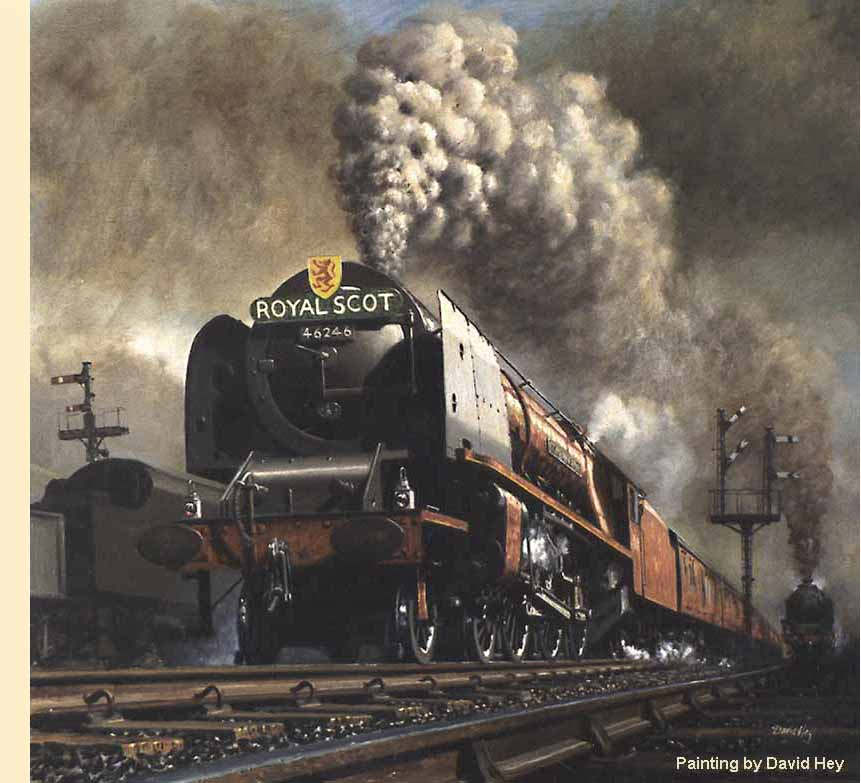 was a ruthlessly competitive place ruled by peer pressure and predatory bullies not too far removed from prehistoric cavemen in the Palaeolithic period. I had to make a no-nonsense, spur-of-the-moment decision on what my heart desired the most - chasing dirty steam locos (virtually clinging on for dear life) or curvy girls?
It was a no-brainer. The clear winner by a mile was girls, the loser being my motley collection of Ian Allan enamel badges and prized ABCs which I unceremoniously dumped out of sight never to be seen again, and that was the end of that!
Now I am not about to launch into some rabid tirade or play the self-pitying old geezer wrapped up in victimhood, I'll leave that to the stick-insect girls whose lives I made a misery all those years ago, but I will say this…sadly there is a disturbing trend - more so in today's unforgiving society - where train spotting is considered immature, and in many ways this is true on the surface, but delve a little deeper and you'll discover a very complex and wonderful hobby. Perhaps the anorak bashers will get a clearer picture on this website...
RIGHT! Enough waffling from me...down to business...
NEW PAGES and UPDATES
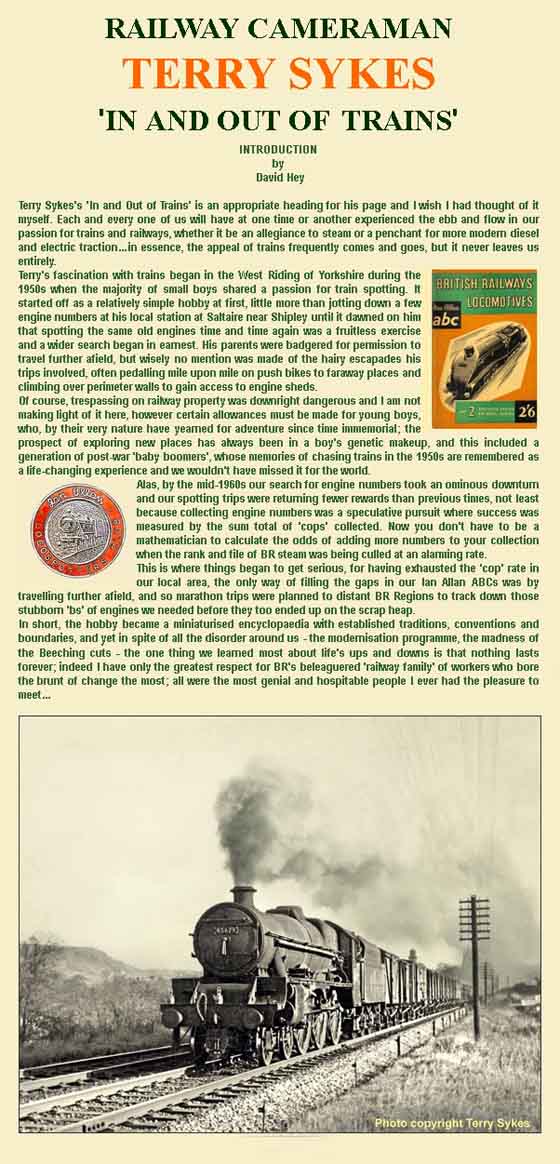
Three new pages have been added, starting off with Terry Sykes's 'In and Out of Trains', which is an appropriate title for his page and I wish I had thought of it myself. Each and every one of us will have
 at
at one time or another experienced the ebb and flow in our passion for trains and railways, whether it be an allegiance to steam or a penchant for more modern diesel and electric traction…however the appeal of trains frequently comes and goes, but it never leaves us entirely. Terry's fascination with trains began in the West Riding of Yorkshire during the 1950s when the majority of small boys shared a passion for train spotting. It started off as a relatively simple hobby at first, little more than jotting down a few engine numbers at his local station at Saltaire near Shipley until it dawned on him that spotting the same old engines time and time again was a fruitless exercise and a wider search began in earnest. His parents were badgered for permission to travel further afield, but wisely no mention was made of the hairy escapades his trips involved, often pedalling mile upon mile on push bikes to faraway places and climbing over perimeter walls to gain access to engine sheds. Of course, trespassing on railway property was downright dangerous and I am not making light of it here, however certain allowances must be made for young boys, who, by their very nature have yearned for adventure since time immemorial; the prospect of exploring new places has always been in a boy's makeup, and this included a generation of post-war 'baby boomers', whose memories of chasing trains in the 1950s are remembered as a life-changing experience...click on image (left) to visit the page.
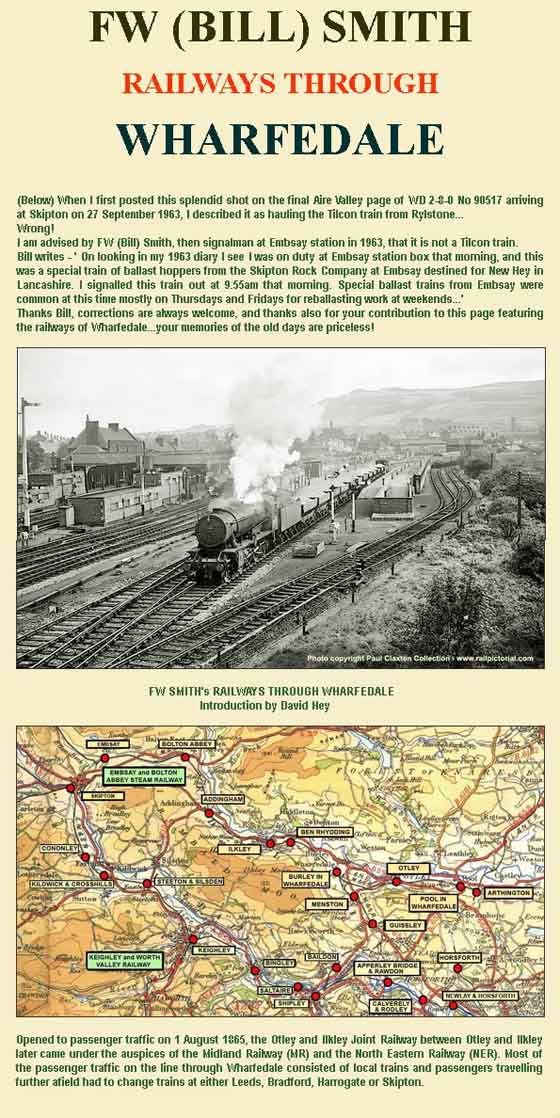
(Right) When I first posted this shot (courtesy of Rail Pictorial.com) on this site, I stated that WD 2-8-0 No 90517 was arriving at Skipton with the Tilcon train from Rylstone on 27 September 1963.Wrong!
I am advised by FW (Bill) Smith, then signalman at Embsay station in 1963, that it is not a Tilcon train. Bill writes -
'On checking my 1963 diary I see I was on duty at Embsay station box that morning, and this was a special train of ballast hoppers from the Skipton Rock Company at Embsay destined for New Hey in Lancashire. I signalled this train out at 9.55am that morning. Special ballast trains from Embsay were common at this 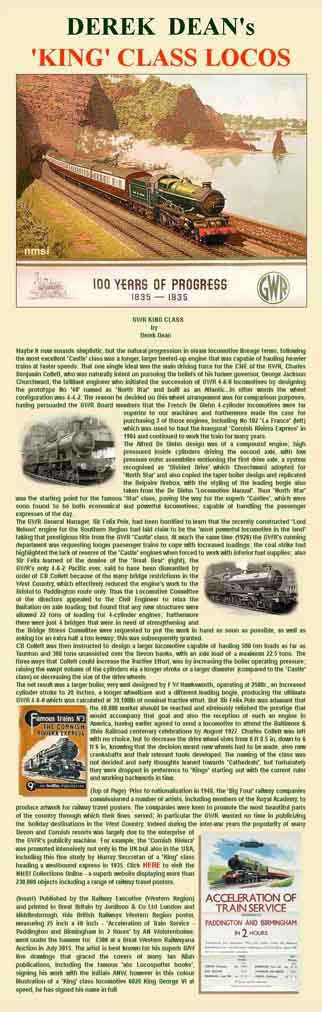 time mostly on Thursdays and Fridays for reballasting work at weekends...'
Thanks Bill, corrections are always welcome, and thanks also for all your hard work in creating your new page featuring the railways of Wharfedale...your memories of the old days are priceless!
Click on image (right) to visit the page...
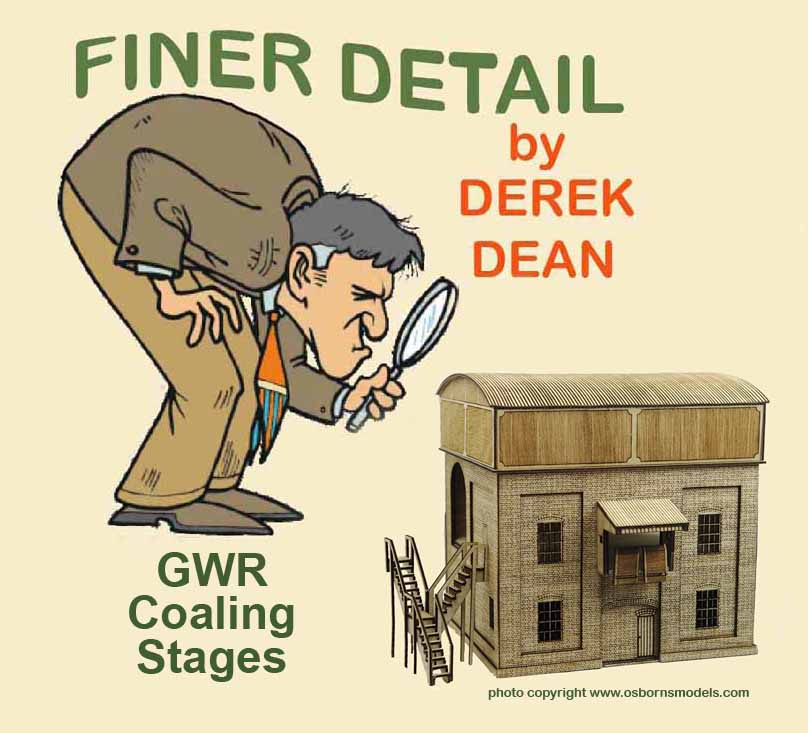
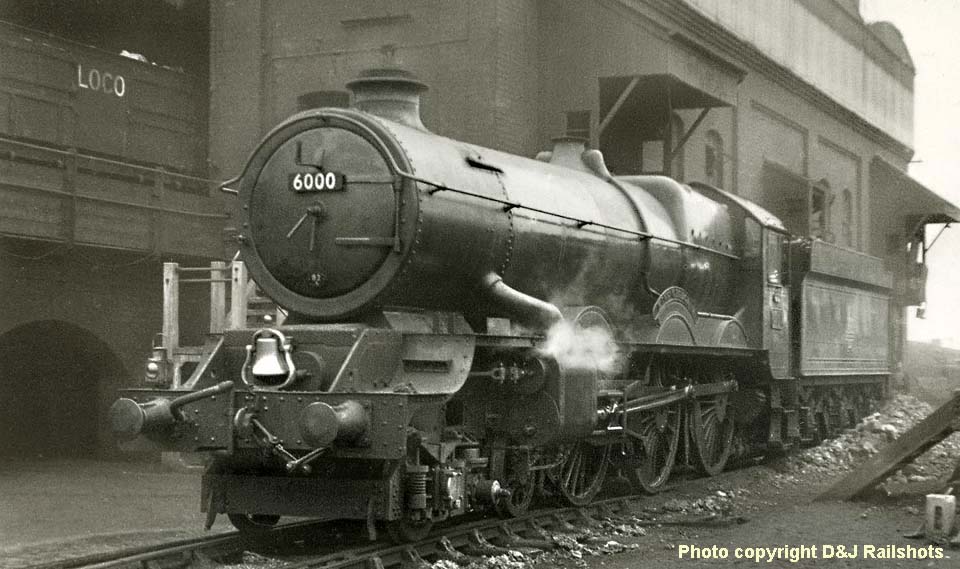
(Left) Derek Dean's memories of the ex-GWR 'King' class locomotives begins at Birmingham Snow Hill station when he was a small boy in the early 1950s.
He writes - 'The 'Kings' were exceedingly photogenic, having clearly defined lines; the immense boiler topped off with a neat, not over-sized chimney and the bulbous smokebox door created an impressive look that distinguished the class from the 'Castles'.The unique leading bogie with its all-powerful looking front stretcher frame and outside bearings, coupled with the diagonal lines of the main frames enclosing the inside valve chests enforced a look of pure solidity that had no equal on the Western Region…'
For the benefit of the discerning railway modellers,beneath every picture on the page is a list of 'BR Modifications' numbered 1 to 10 which cover such things as the fitting of a raised step over the inside cylindersbelow the smokebox to the re-positioning of the mechanical lubrication unit, and each listed modification is tailored todescribe the detail differences that are visible in the photo taken on a particular date as quoted in the captions. Click on page image left to visit the page.
(Below) The 'BR Express Trains' page 39 HERE has been updated with a number of individual timetables kindly scanned by David Baldwin; they include the timings of titled express trains from the BR(NE) 1961 Summer Service Timetable: 'Passenger Services North Eastern England' from 12th June to 10th September inclusive 1961. Also scans have been added relating to the BR Eastern Region Summer Timetable 17th June to 8th September inclusive 1963 and the London Midland Region's Summer Timetable from 17th June to 8th September inclusive 1963. Of particular interest to me are the Anglo-Scottish expresses serving the MR route from St Pancras to Glasgow which had to reverse at the Leeds, including the 'Thames-Clyde Express'. Perhaps older enthusiasts will recall the Fifties and Sixties when both 'up' and 'down' trains were booked to arrive at Leeds at the same time - approximately 14.30. However, because of the length of both trains, the island platform 5-6 had to be used, therefore passengers entering the station found themselves facing two identical expresses standing side-by-side, each carrying non-reversible 'London-Leeds-Glasgow' roof boards on the carriages, and as both the 'up' and 'down' trains arrived and departed in the same direction, the station staff had to make sure that no hapless passenger ended up travelling in the opposite direction they intended! It later transpired that Skipton became the passing point.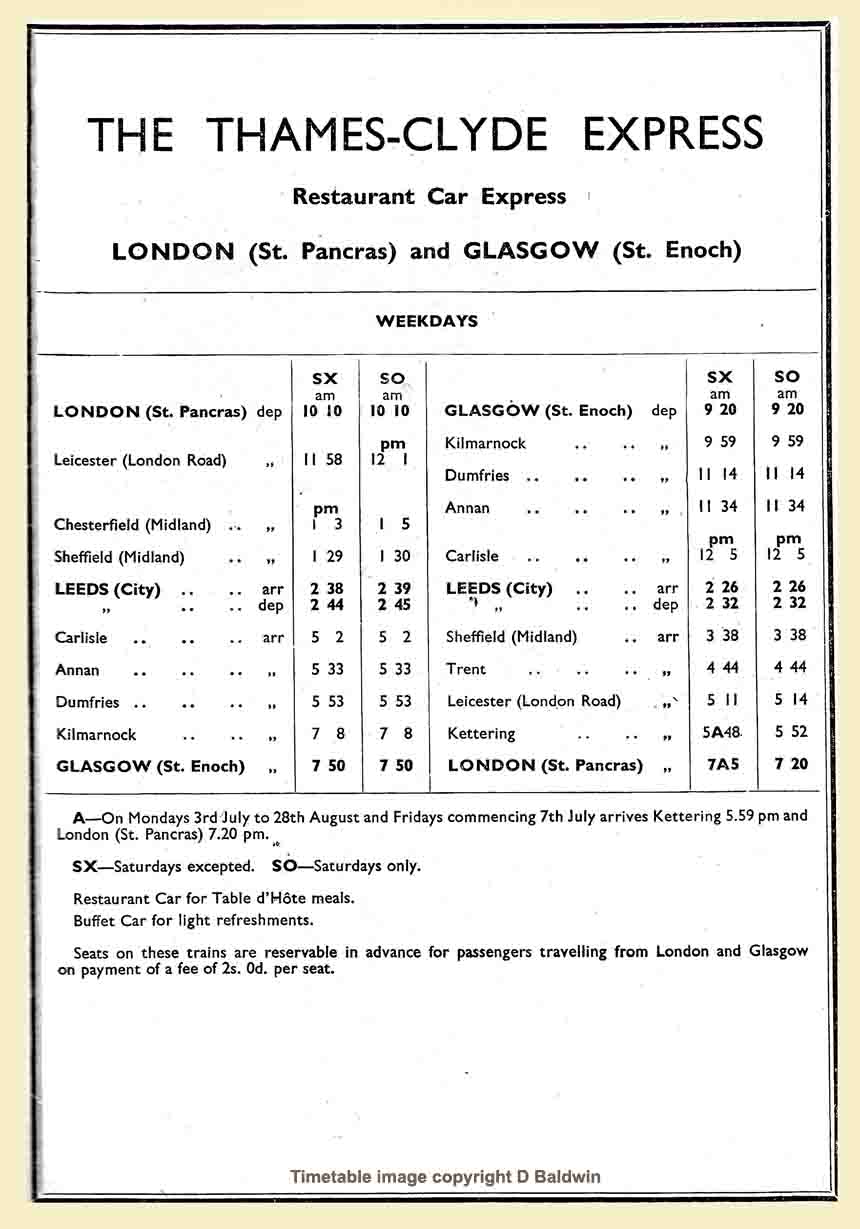
(Right) Page updated...Following the success of Andy Sparks's first two books - 'British Rail Northern Scene, A 1970s Railway Album' and 'British Rail Northern Scene, Coast to Coast' - both concentrated on 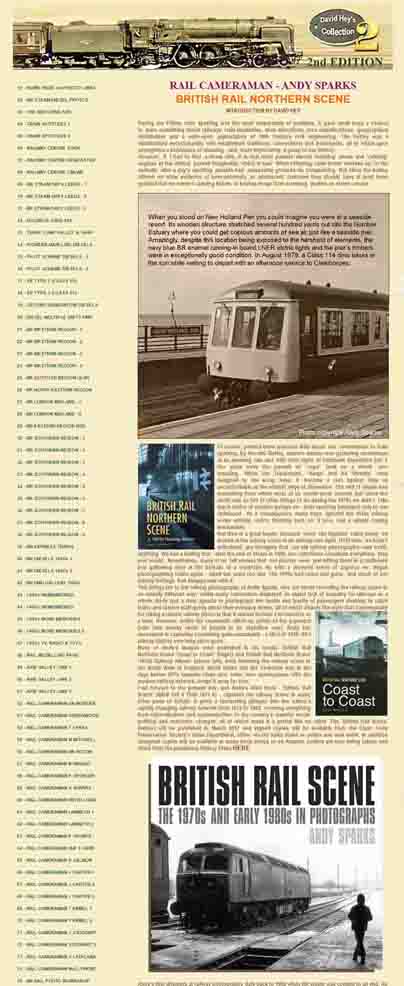
 the North West of England, North Wales and Yorkshire area, Andy is now launching a third book, 'British Rail Scene' (ISBN 978 0 7509 7013 6),which spreads the net even further.
Andy's first attempts at railway photography date back to 1968 when BR steam was coming to an end. He was just 9 years-old when he acquired a Kodak Brownie 127 camera from a local junk shop, but his earliest attempts at railway photography never matched his aspirations and so he gave it up until he was a little older. In the meantime, he spent many happy hours train spotting and pouring over timetables, books and magazines to 'gen up' on railway facts and figures; and in a bid to develop his own particular style he studied the various compositions of the railway photos.
His favourite photographer by far was Colin T Gifford, whose knack of capturing so much of the railway infrastructure in one single picture made him realise just how quickly the railway scene was changing. Over the years Andy's quest to photograph the changing scene has yielded thousands of images, most of which have either been lost or destroyed, yet others have survived, including several unprocessed films which have astonishingly produced usable photographs twenty five years after their use-by dates. Thanks to the wonders of modern technology, he has been able to create a series of themed chapters to produce several books. His latest - 'British Rail Scene' - is both informative and an unashamed wallow in nostalgia…something he hopes that readers will enjoy dipping into time and time again. Click on page image (above right) to visit the recently updated page…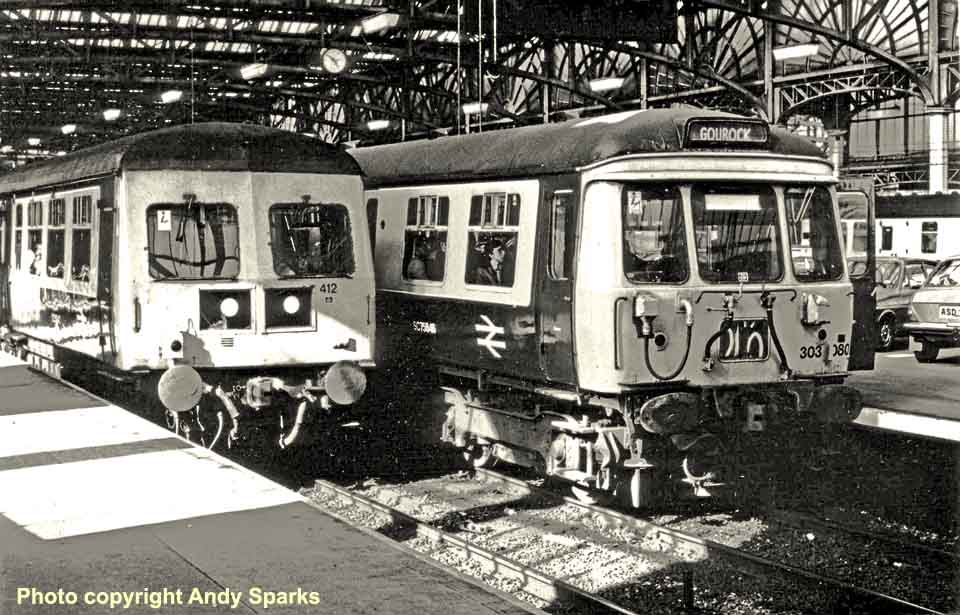
(Above) During the 1960s Andy Sparks saw lots of books and posters with images depicting the rather stylish 'Blue Train' Class 303 and 311 EMUs operating in the Glasgow area. Like the Southern EMUs, he found them rather exotic but for a long time they were alluringly inaccessible. Little did he know that the Class 303s would be drafted closer to home in the Manchester area, primarily to replace the withdrawn Hadfield-Glossop Class 506 EMUs, hence they became a commonplace sight during the 1980s. In this shot at Glasgow Central in 1979 he hadn't enough time to sample either of the tempting delights depicted here. Both trains were ready to depart but he was soon to return home on the afternoon train to Manchester, a journey involving Class 87-haulage to Preston followed by a Class 47 for the final leg to Manchester Victoria. The DMU on the left is one of the Swindon-built Class 126 3-car sets; these units had very different front ends - a standard full-width cab at one end (as seen here) and a half-cab incorporating a central  gangway connection at the other; the idea being that two 3-car sets could be coupled together to create a double-length 6-car train with a corridor access throughout…good in theory, but not in practice if the train ends were the wrong way round! On the right 303 080 is ready to depart for Gourock, a rather pleasant destination.
(Below Right) I am pleased to announce publication of the third page of Ed Chaplin's 'Great Way West' (GWW) which describes the journey by train between Castle Cary and Newton Abbot on the BR Western Region's London Paddington to Penzance main line during post-WWII. Click HERE to visit the new page.
Like the previous pages, the journey has been broken down into three sections: Castle Cary to Taunton - Taunton to Exeter St David's - and Exeter St David's to Newton Abbot. In all, the 305-mile trip from London to Penzance will feature more than 450 photographs covering a period of BR steam operations during the Forties and Fifties.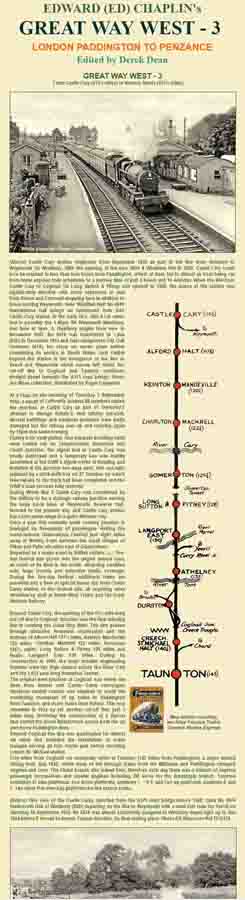 This remarkable piece of writing is the final work of the late Ed Chaplin whose passion for all things 'Great Western' shines through. The high standard of research required to accurately get across 'his own take' on this marvelous GWW route was extremely important to him, therefore the pages can be considered very much a joint effort.
Ed writes - 'I cannot stress too highly what a delight it has been to collect to receive letters and emails from several people, in particular Ben Brooksbank, Roger Clemo, Derek Dean, Derek Frost, Chris Hawkins, Colin Stacey, John Copsey, Paul Tomlinson, Richard Woodley and CT Wray. All have answered my questions and generously given much relevant information from their own  research over many years. So, while it may be my name as collator, chooser of photographs and writer of text, my sincere thanks to all the persons involved.'
Meanwhile, the fourth 'Great Way West' page from Newton Abbot to Plymouth North Road is currently in the planning stage.
Finally, I am extremely grateful to Derek Dean who kindly volunteered to edit all the pages. Quite simply I couldn't have done it without him…thanks Derek.
(Below) 'King' class No 6002 King William IV of Laira shed leans to the curve at Teignmouth on train A79, the 8.20am SO Penzance-Paddington, hoping for a fast run to London, however with so many Saturday Holiday extras running on Saturday 30 July 1960, its scheduled arrival time in the capital is highly unlikely. Built in July 1927, No 6002 has barely another two years of reliable service remaining, being withdrawn in September 1962. Shortly after this photo was taken, the 'Warship' and 'Western' class diesel-hydraulics had taken over the West of England express duties and No 6002 was given useful employment on the Paddington-Wolverhampton expresses. The quite severe camber on the curve is very pronounced in this image by Jim Davenport, Initial Photographics.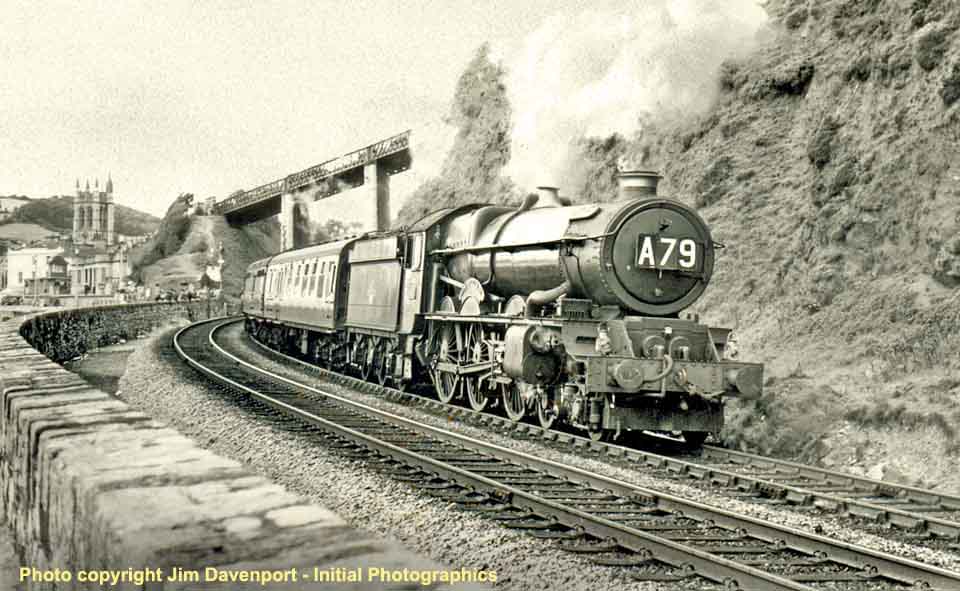
(Below) Derek Dean's page 24 has been updated with a gallery of 'King' photos, including this classic shot of No 6014 King Henry VII heading a Down express near Cullompton Devon in 1936.
Legend has it that the erudite CME of the GWR, Charles Benjamin Collett, was not enamoured by the prospect of the company 'streamlining' one of his beloved 'King' class locomotives. The decision was taken by the GWR's Directors' to satisfy their need to be in vogue and share in the limelight of publicity.
The perceived desecration of No 6014 took place in the early months of 1935, swiftly followed by No 5005 Manorbier Castle which endured a similar fate. Thankfully, the full encumberment of cylinder and steam pipe fairings only lasted five months, while the additional 'bullet nose' remained until the end of 1942, giving rise to two additional fittings being added - an extra grab handle on top of the smokebox and a cleat fitted over and in front of the inside cylinder lubrication container. The supplementary handle aided the crew to release the nose-cone and the cleat gave an alternative fixing for the reporting number frame which came into use in 1935.
From a mechanical standpoint the adaptations were only beneficial when moving into a headwind and even then the actual gain was minimal. From the aesthetic catastrophe that was the first seen alteration, the view here reflects a more acceptable appearance, if rather different to the norm, which remained unaltered for a little over seven years. The single section wheel splashers were returned to three conventional covers in 1944, but the distinctive wedge-shaped cab remained to the end of the engine's service life in 1962.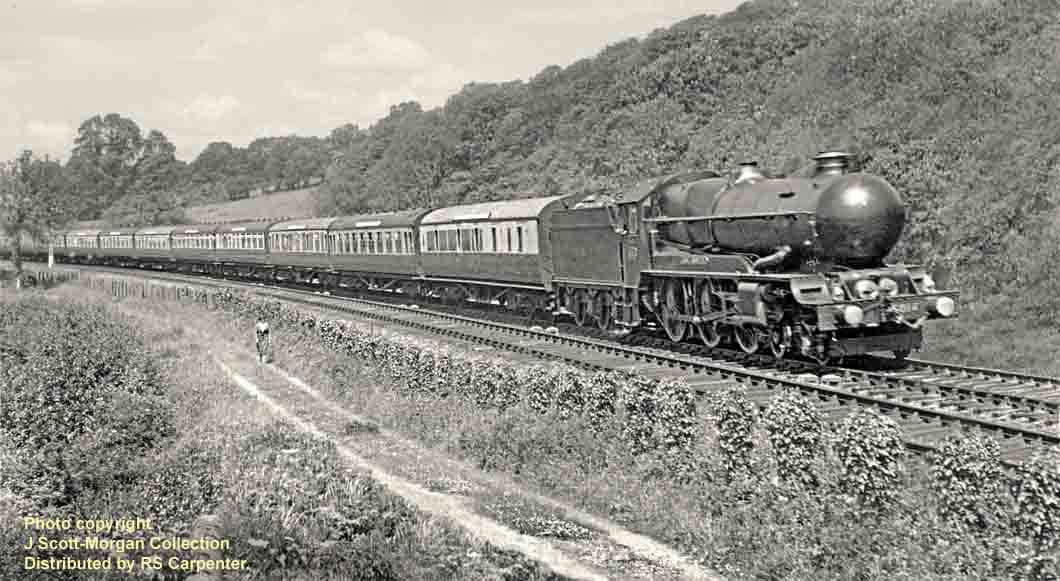
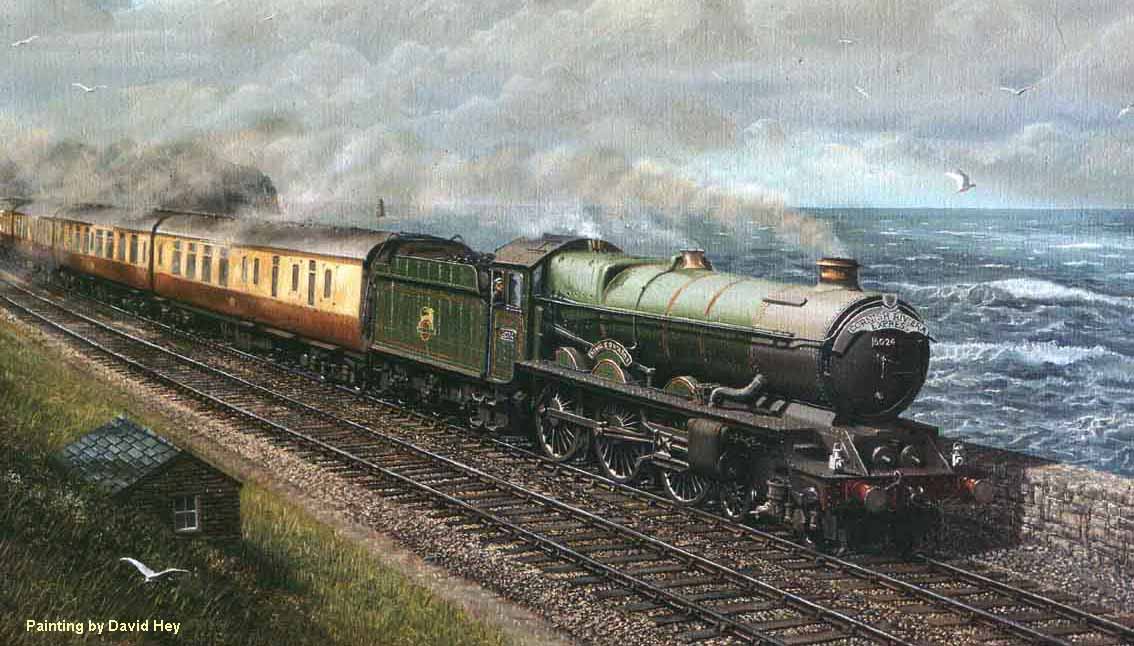
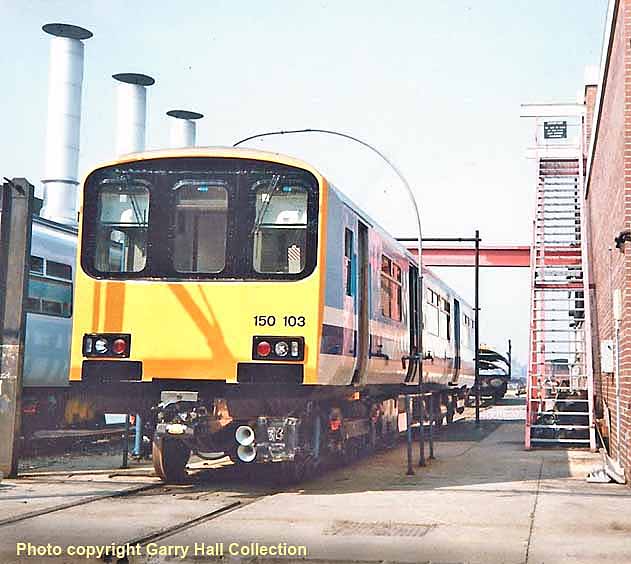
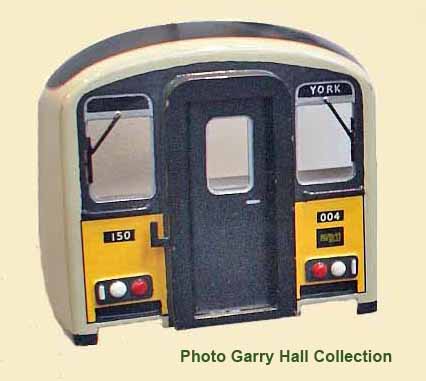 excursion traffic to Bridlington, Filey and Scarborough on the Yorkshire coast. By 1961 he had acquired his very first Ian Allan Combined abc costing the princely sum of 10/6d from York station's WH Smiths, and after leaving York Technical College on Tadcaster Road it was inevitable he would end up working on the railway; in August 1968 he started an apprenticeship with British Rail as a sheet metal worker at the York Works Training School, coincidentally the same month that steam finished on BR. Garry talks about his 27 year-long career at the Carriage Works on the Holgate Road site, which came under the auspices of BR/BREL (British Rail Engineering Ltd) during the 1980s. Being an avid railway modeller, he loved every minute of being a railway worker, especially as it involved producing many precision models of the vehicles that rolled off the production line at the Carriage Works, including the Class 150 Sprinters. Click HERE to read Garry's story on the revised 'Rail Centre York' page.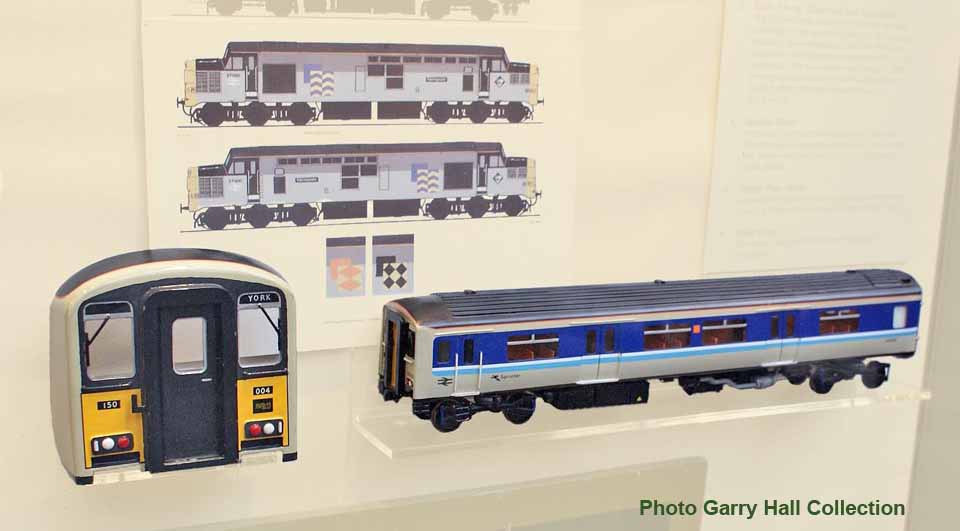
(Below) Website proprietors will tell you that the most rewarding part of building a site comes from its creation and then (hopefully) propelling it forward to achieving bigger and better things. But this demands 100% commitment and keeping tabs on even the smallest detail such as informing visitors of the latest site updates, otherwise what's the point in updating!
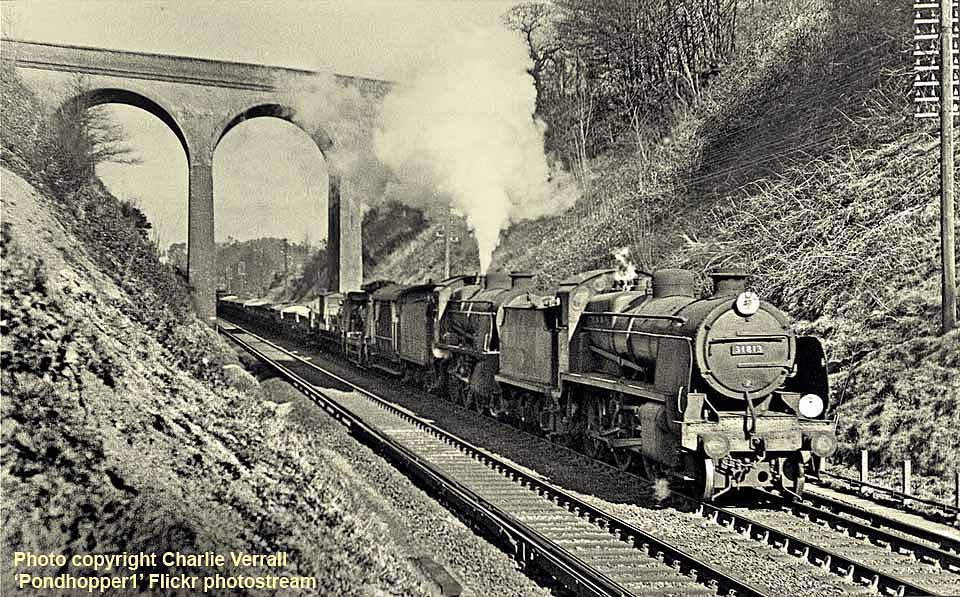
It occurred to me that this happened some weeks ago when I failed to mention uploading a super collection of photos taken by Charlie Verrall on a new 'BR Southern Region - 9' page HERE. Charlie Verrall is perhaps better known as 'Pondhopper1' on Flickr's online photo management facility; indeed the quality of 'top drawer' railway photographs to be found on the Internet is getting better by the day.
Charlie's interest in trains began at a very early age. His grandfather was a footplateman on the London Brighton & South Coast Railway (LBSCR) and Southern Railway, and his uncle was on the footplate with both the Southern and BR, plus his father was also a railwayman - so it's not surprising that he would follow family tradition. He began working for British Railways in 1953 and the page features many fine pictures, including his oldest surviving negative (left) of ex-Midland Railway 0-6-0s 58137 and 43829 at Cricklewood shed on August 2nd 1950. (Below) The 11.48am Engineers train from Three Bridges to Eastbourne is double-headed by N Class 2-6-0 31813 and U1 Class 2-6-0 31897 between Haywards Heath and Wivelsfield on February 24th 1962

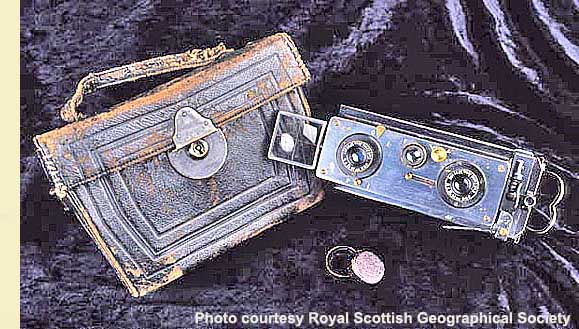 I have recently been contacted by Rail Cameraman, John Stoddart (see pages 71-72). It concerns an aspect of railway photography that rarely gets a mention on the web; I'm talking about stereoscopics, better known as 3D imaging, which is a technique for creating the illusion of depth by means of stereopsis for binocular vision.
John's friend, Ben Clifford, has scanned a number of his grandfather's old photos circa 1900-1935 for archiving purposes. Ben is pretty certain the camera used was a Richard Verascope which took 44mm square images. A similar camera belonging to the Scottish explorer William S Bruce was donated to the Royal Scottish Geographical Society by Bruce's granddaughter Moira Watson of Hamilton, Ontario. Details of the camera and case (above) can be found in
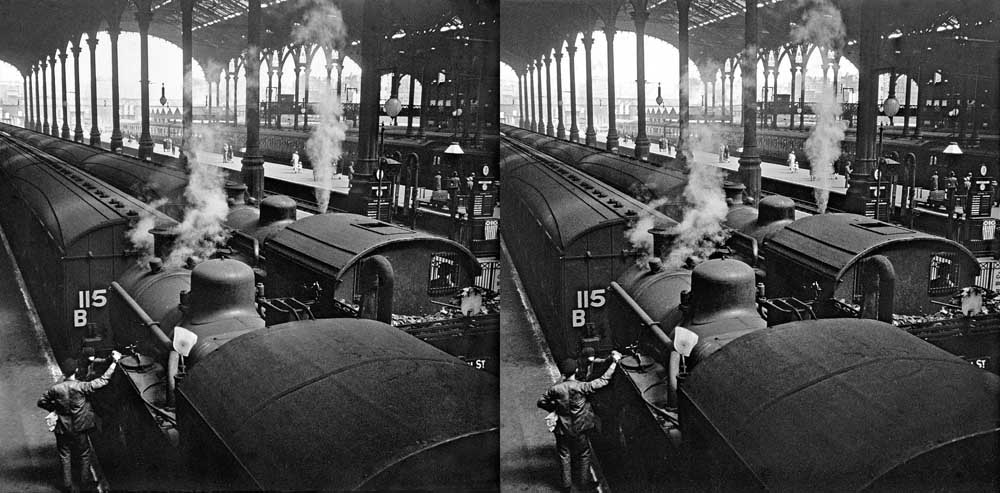
Ben is converting the stereoscopic photos into 3D images viewable with red/cyan glasses. One stereoscopic slide (above) was taken at Liverpool Street station in 1928, and shows the famous old roof
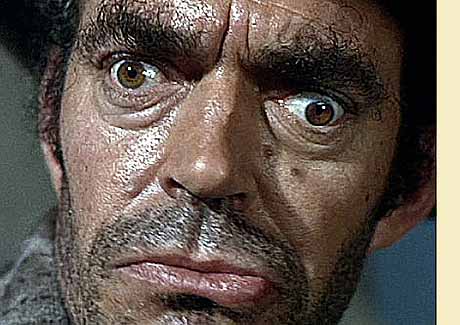 with two local trains in the foreground. Ben has scanned this slide in a significantly higher resolution than shown here, however I am advised that there is nothing to be gained in uploading a higher resolution version since a 3.8 megapixel image pair is right at the resolution of a Mac with a 1440p display, and is also just sufficient to show the grain structure of the original 40 mm square images. It should also be noted that parallel viewing without some sort of viewer is difficult, and with large image pairs almost impossible since it requires 'wall-eyed' viewing of the pair. Jack Elam, the cowboy actor (above left) would have been a natural!
Needless to say, the 3D process is a fascinating subject but I lack the savvy to explain how it works in laymans' terms. Thankfully John has kindly stepped into the breach...
He writes - 'David, although you are posting Ben's full narrative on Page 2 (link below) perhaps an explanation of 3D in its simplest form will be of benefit to the casual viewer…
 The key to understanding stereoscopic imagery is knowing how the eyes actually see things and how the brain interprets what they see. Start by placing your finger against your nose. Each eye sees the finger from a different angle and presents a separate view to the brain. This is how we see everything at any distance. Obviously, the further away something is, the closer those two images coincide. The brain combines those two images into one and turns the difference between them into our sense of depth and perspective - the third dimension.
Stereoscopic photography mimics what the eyes actually see by taking simultaneous photos through lenses the same distance apart as our eyes - about 70mm. At first sight, the stereoscopic images of Liverpool Street station are exactly the same. But look carefully and you'll see that slightly more of the train's destination board is visible on the right-hand photo than the left hand one. Almost all of 'St' in the right hand photograph (presumably the tail end of Liverpool St) can be seen but it's slightly chopped-off in the left hand one.
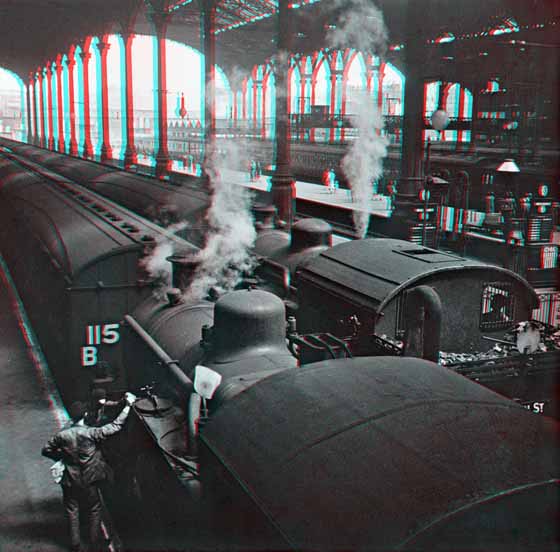
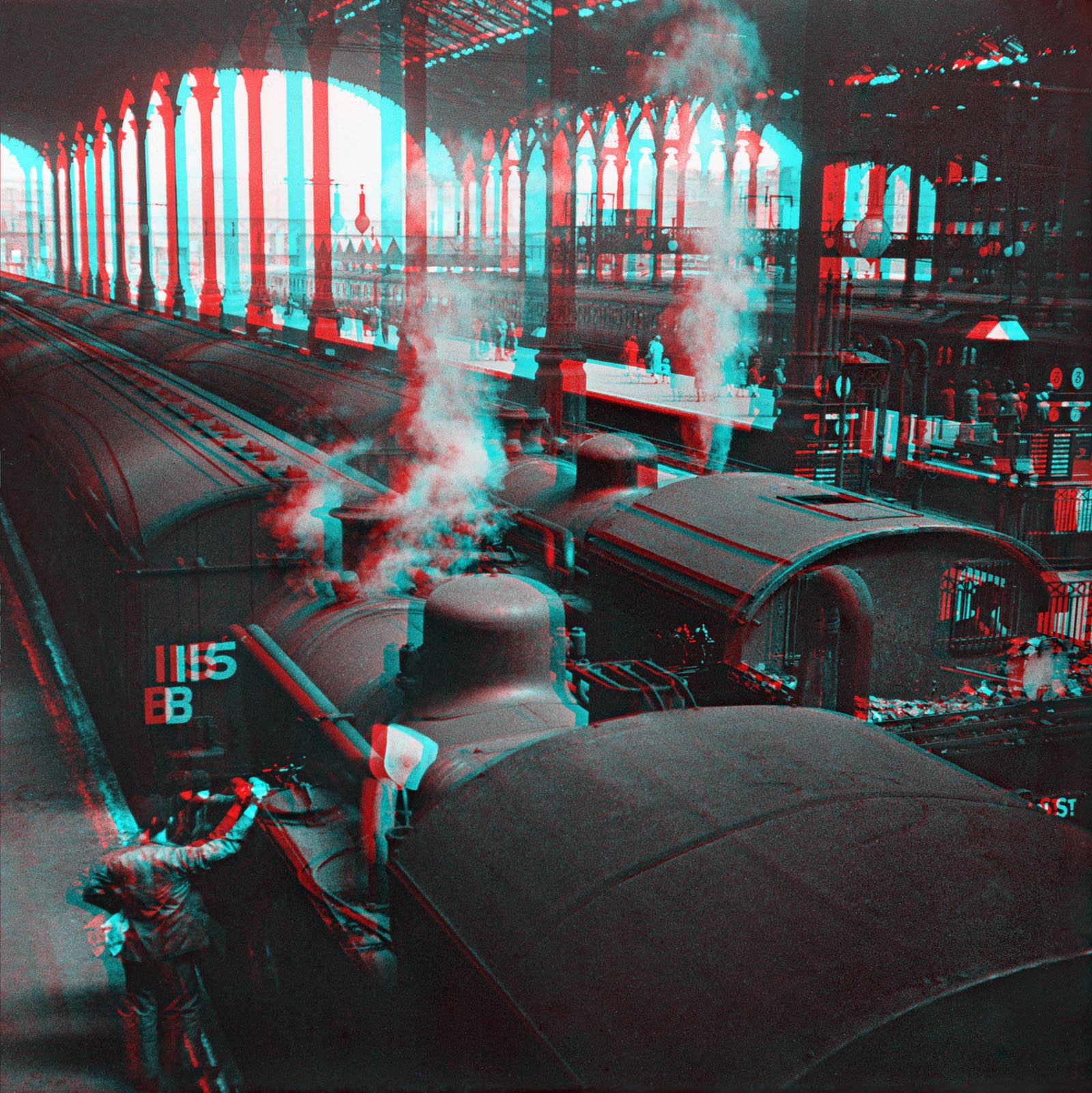
(Left) John continues: 'Ben does have some control over the way the anaglyph is made therefore he has sent two images because the success of the 3D effect seems to vary from screen to screen; he thought he'd let you take a look at both possible alternatives. Here is the first example. Click on image to see the full size (the image will open in a new window).
In the other example (below right) it appears as if the subject material is further behind the so-called 'viewingwindow'; click-on image to see the full size; the image will also open in a new window. These differences can be controlled over quite a wide range. He could make one even deeper, but at some point the effect starts to feel less natural.
 A very close analogy can be gained from
 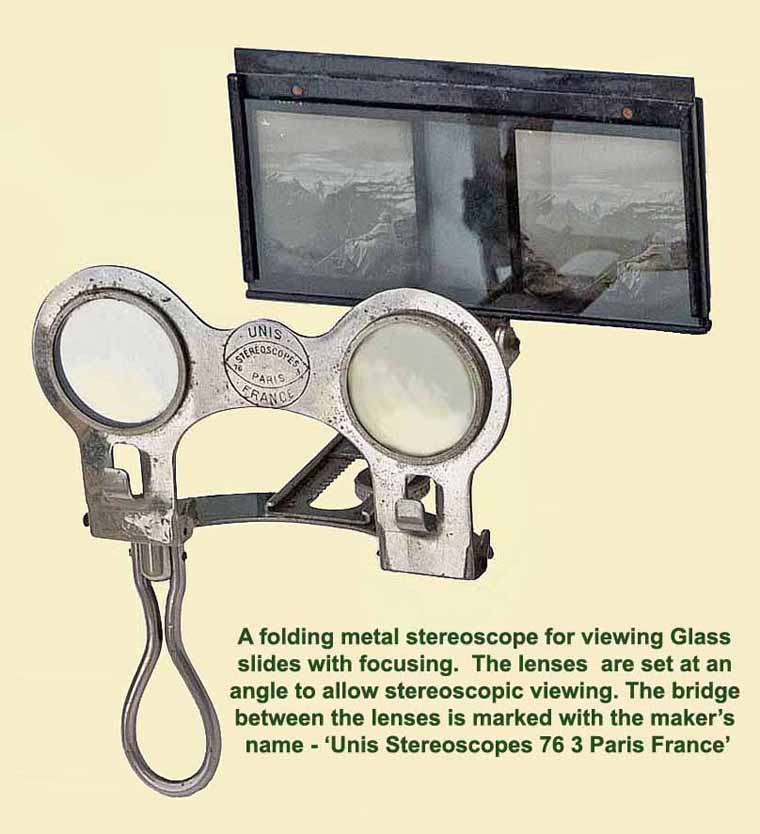 With stereoscopic images, there are three ways (more, actually, but we'll stick to 3 here) to provide that help: 1) The stereoscopic viewer (left) is designed to render a 3D image from side-by-side, printed stereoscopic images, and those designed to view them on a computer screen. 2) With practice, without a viewer, training your eyes to stare at the
 Ben Clifford's fascinating insight can be found on Page 2 HERE
NBL PRESERVATION GROUP
(Below) The NBL Preservation Group was formed in 1990 by a small band of NBL Society members to preserve additional North British steam locomotives outside of the NBL Society's framework.
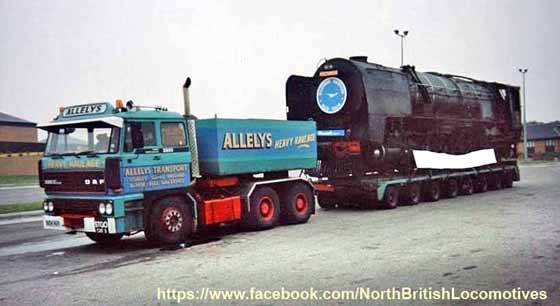
(Above) In October 1991 South African Railways Class 25NC 4-8-4 No.3405 'Bethlehem' became the first locomotive to be saved by the newly formed NBL Society.
A LIFETIME OF MEMORIES RECORDED
 getting around it if you dig deep enough; indeed your lifetime experiences are an exclu
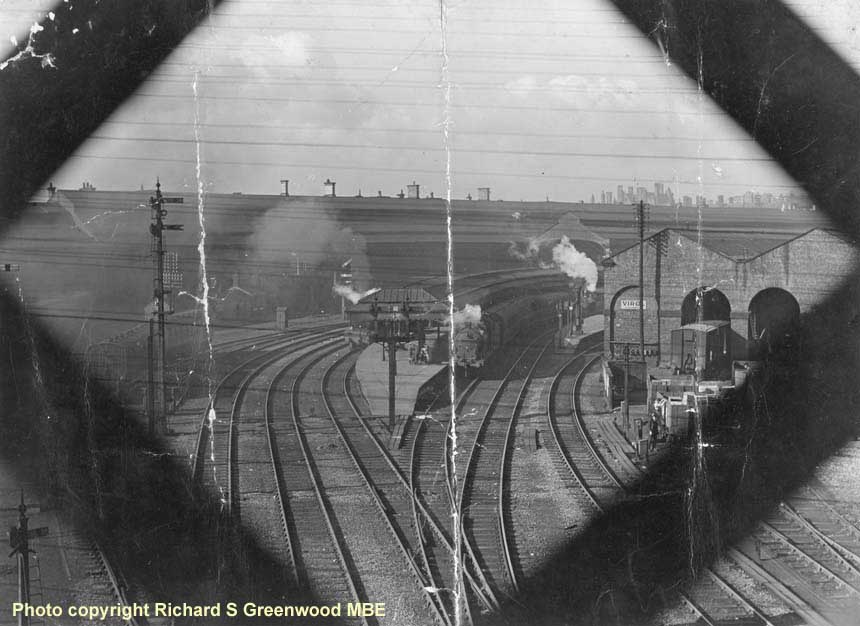
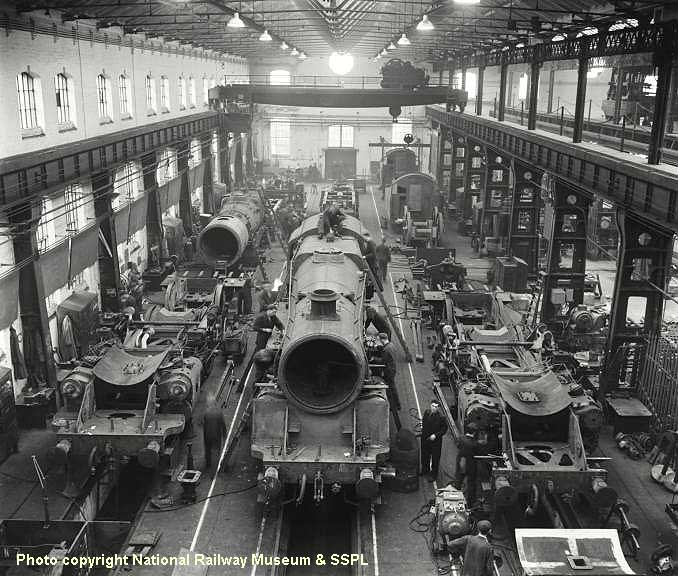
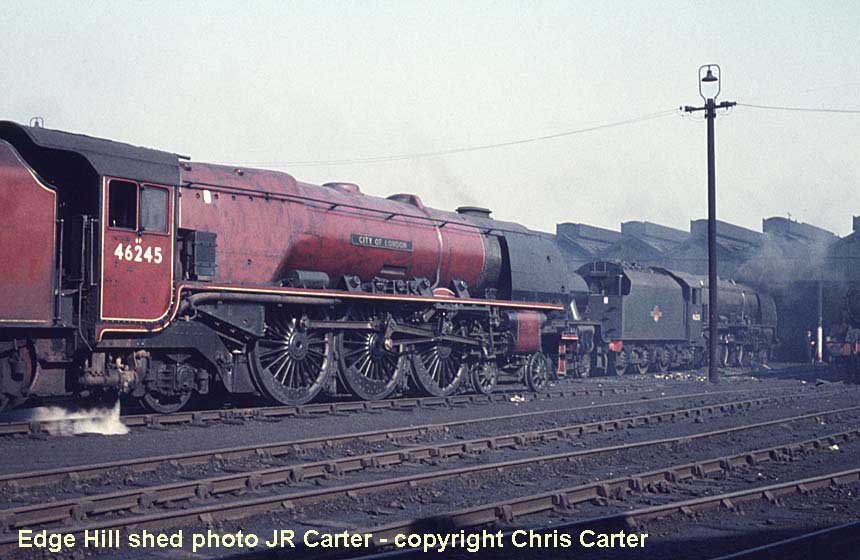
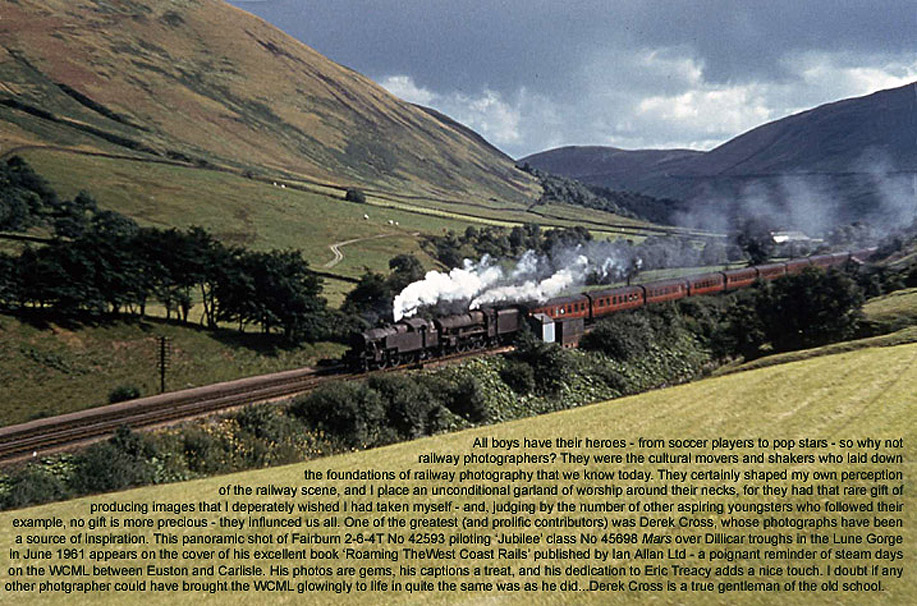
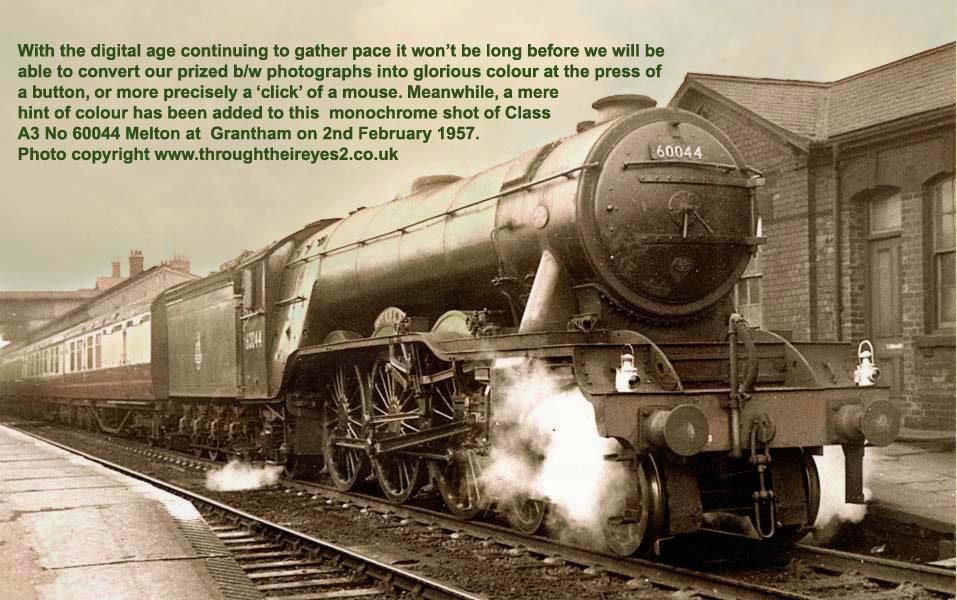
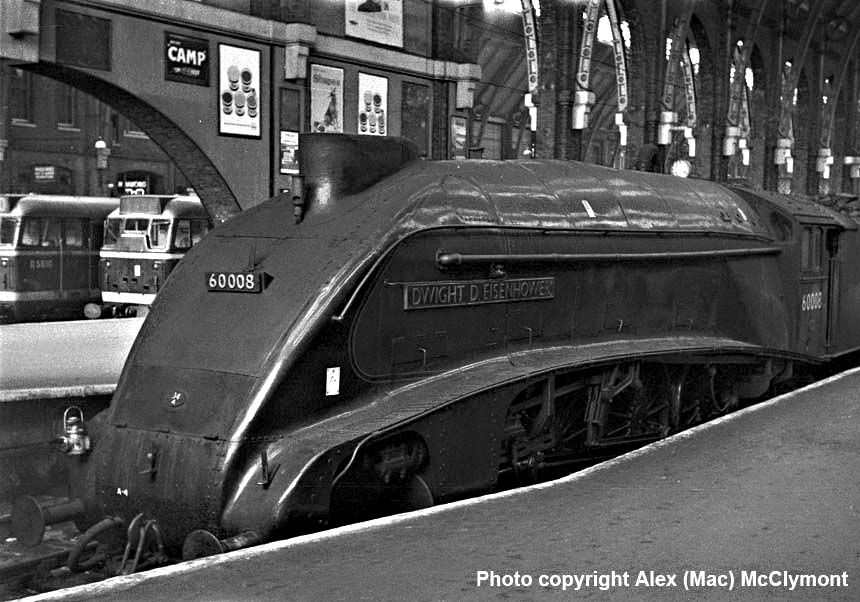
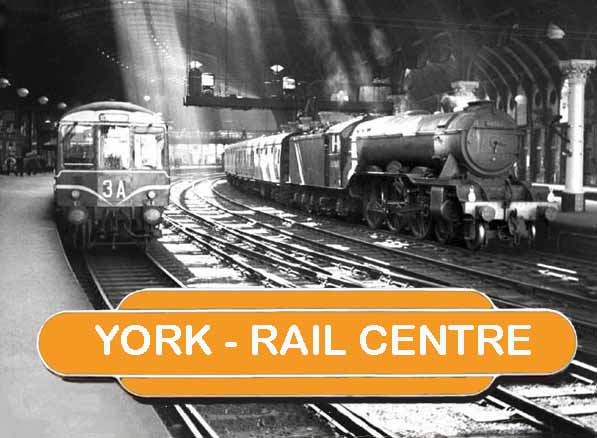
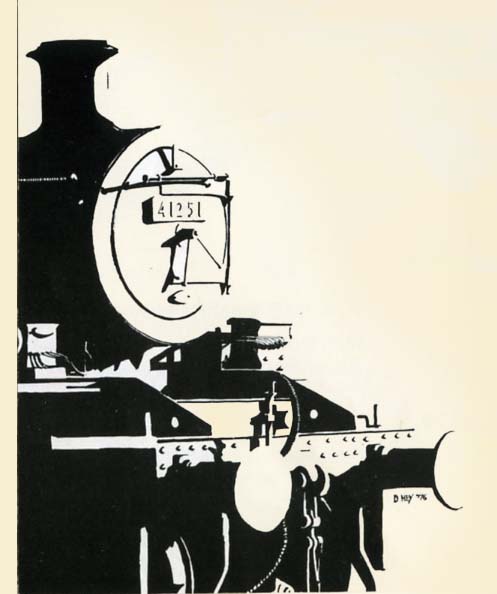 And so it was wonderful news to hear that two expatriate Class A4s Nos 60008 and 60010 have found their way back to Britain to celebrate the 75th anniversary of their sister, 60022 Mallard, which secured the world speed crown in 1938. (Above) A4 Pacific 60008 'Dwight D Eisenhower' at Kings Cross on 15th June 1962.You can read more about the repatriated A4s on the 'Rail Centre - York' page. (Below) Full marks to the NRM, for it is due to the sterling efforts of the staff at the National Railway Museum at York that the A4 duo are now back on home soil. The museum not only houses the largest collection of railway objects in the world, but admission is absolutely free - a good excuse to take the Missus and kids for a brilliant day out! Click here to visit the excellent NRM website.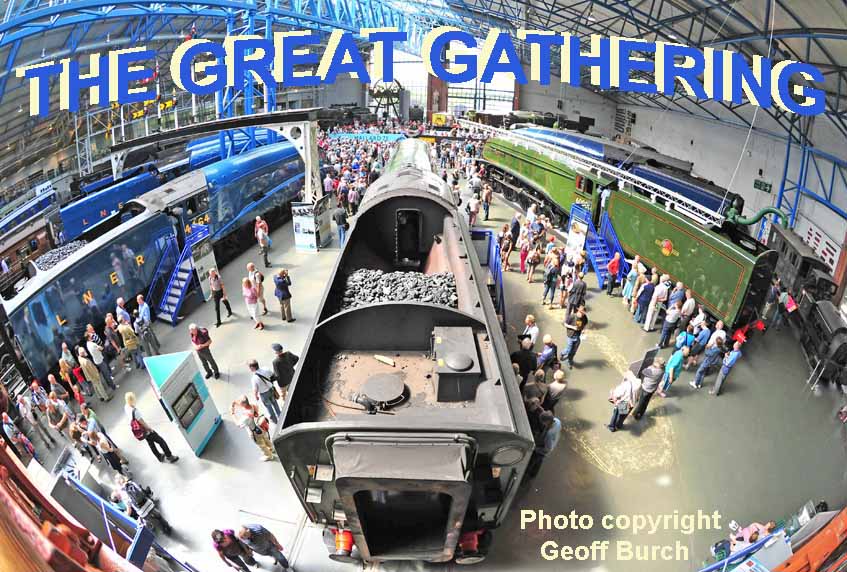
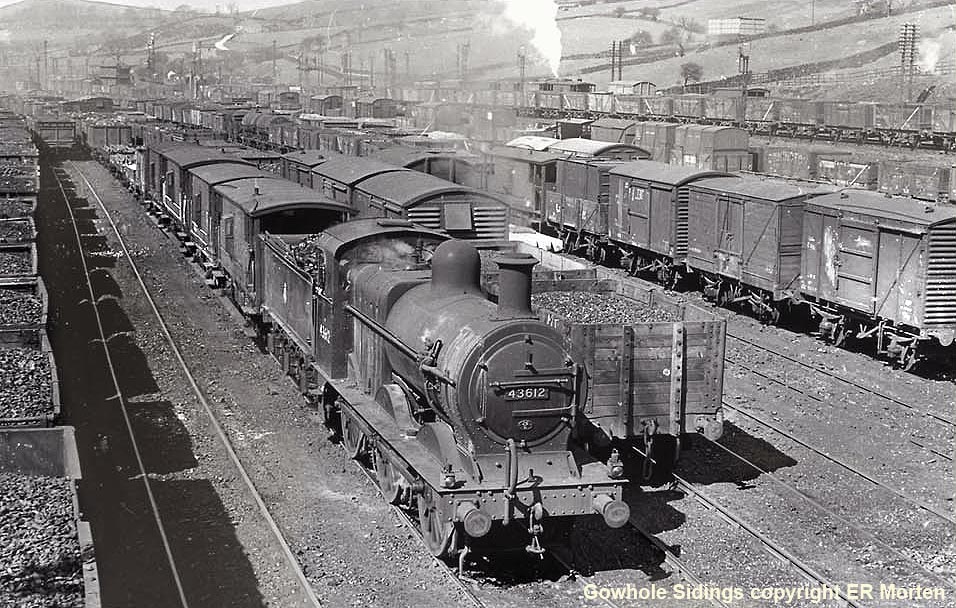
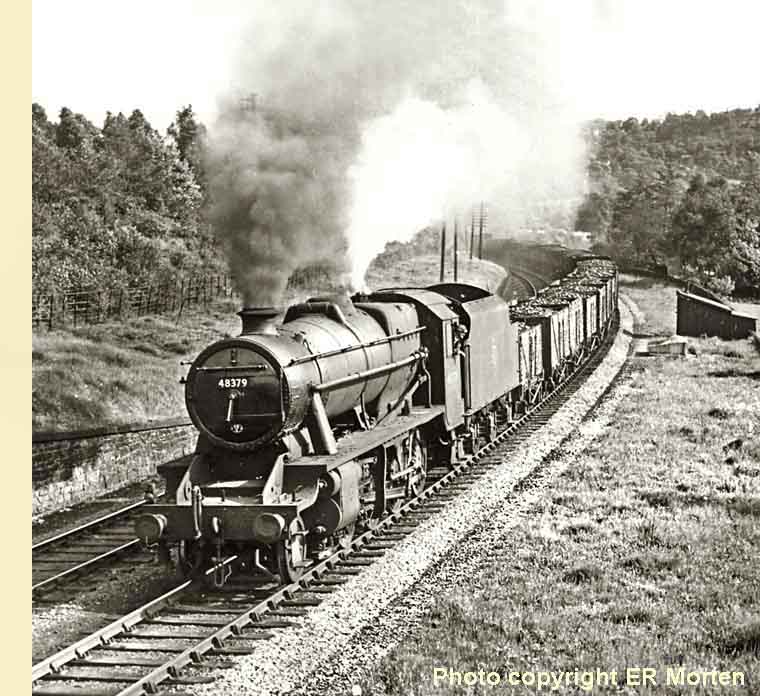
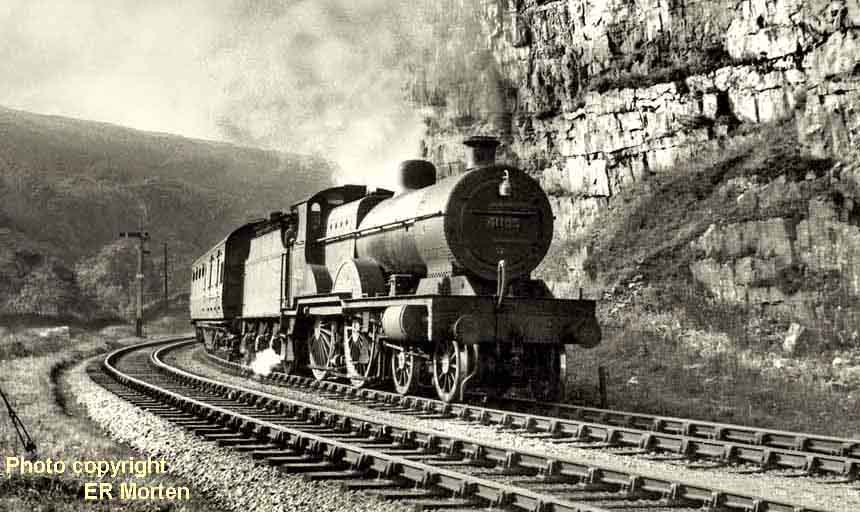
(Above) Railway photographers are creatures of habit, invariably taking the traditional three-quarter shot a train to the exclusion of almost everything else in the surroundings. However, this ER Morten shot of Johnson Midland Class 3F 0-6-0 No 43612 at Gowhole Sidings with a heavy goods train on 21 April 1951 is refreshingly different since it shows the hustle and bustle of a busy railway yard chock-a-block with various loose-coupled freights. With a tractive effort of just 21,010lbs and weighing no more 43 tons, the Class 3F will require the help of a banker and the provision of four brake vans to assist the engine crew over the steeply-graded Peak Forest route to Rowsley.
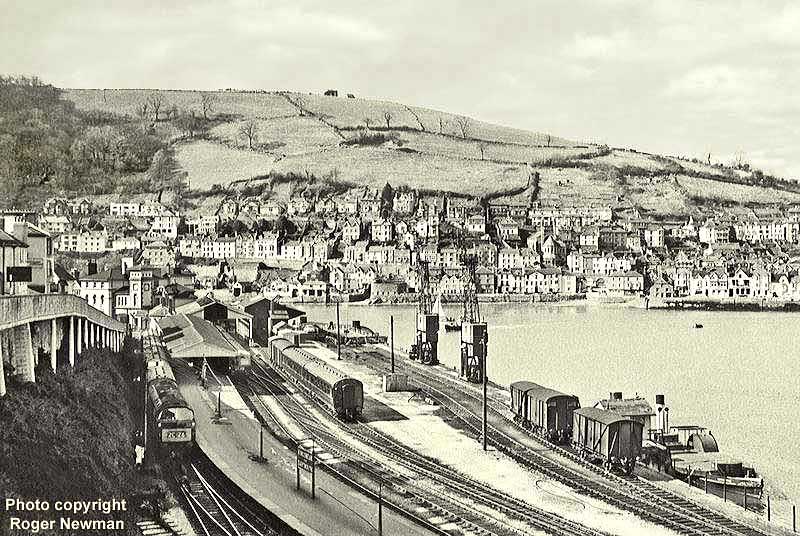
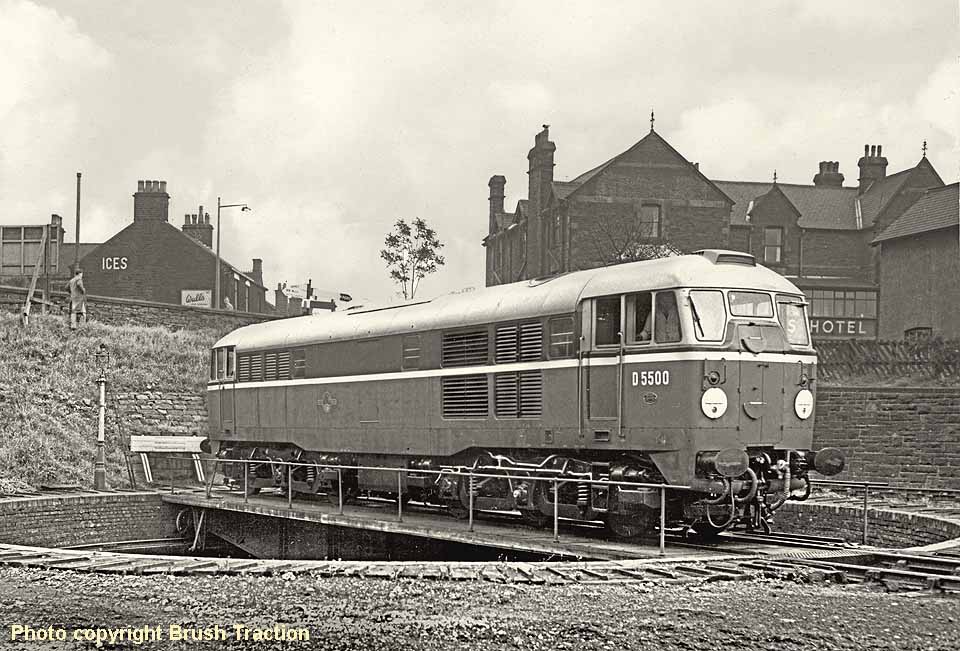
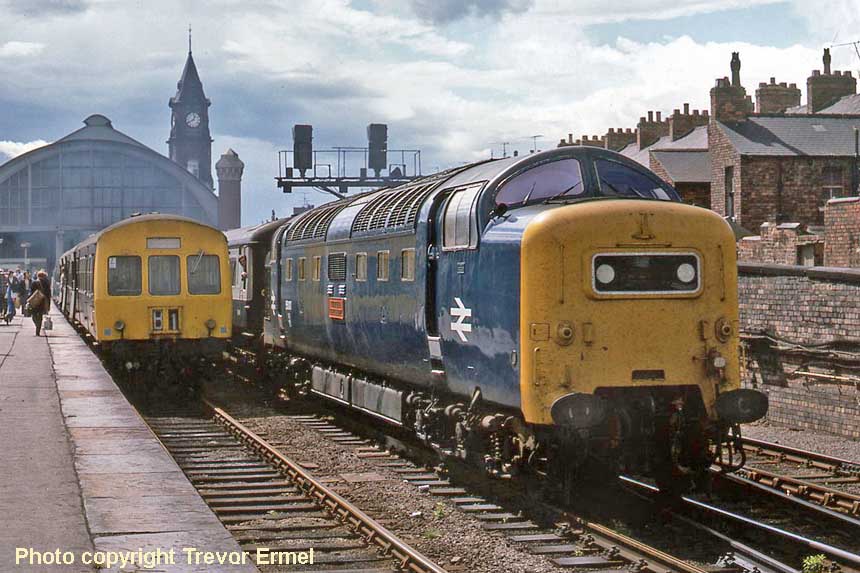
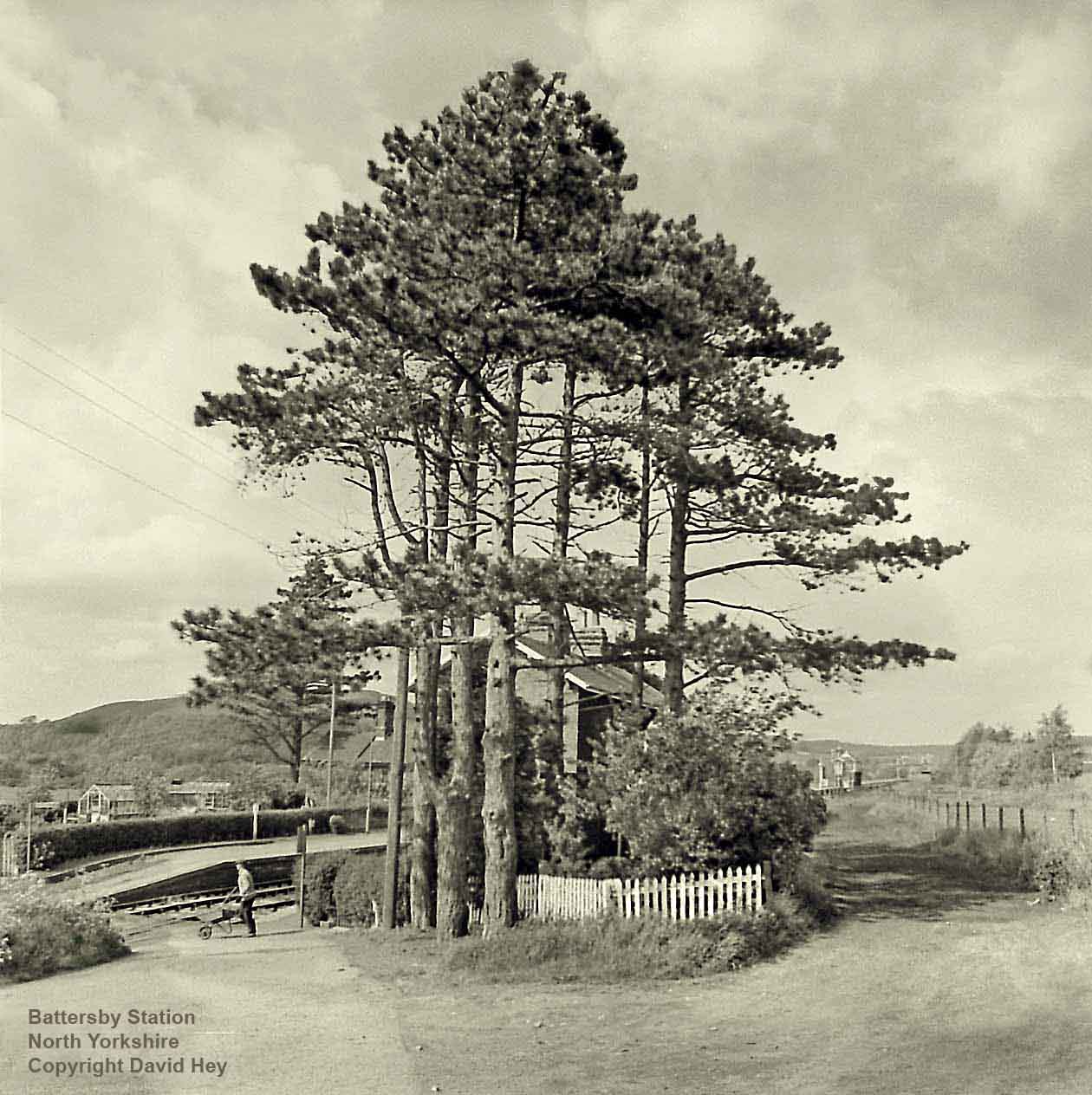
(Below) With the onset of dieselisation some ten-odd years later, the most resolute of steam cameramen found themselves seeking ways of making their pictures more interesting; the absence of any atmosphere created by swirling steam and smoke reduce the chances of a diesel photo being anything like as pleasing as those taken in steam days - hence the inclination to embrace more of the railway infrastructure; indeed some shots dispel the myth that a prerequisite for taking a decent railway photograph is that it should include a locomotive or a train. Whatever the changes in our photo-technique, however, the results are exactly the same - it records the railway scene for posterity. This is Battersby Station on Esk Valley line in North Yorkshire.
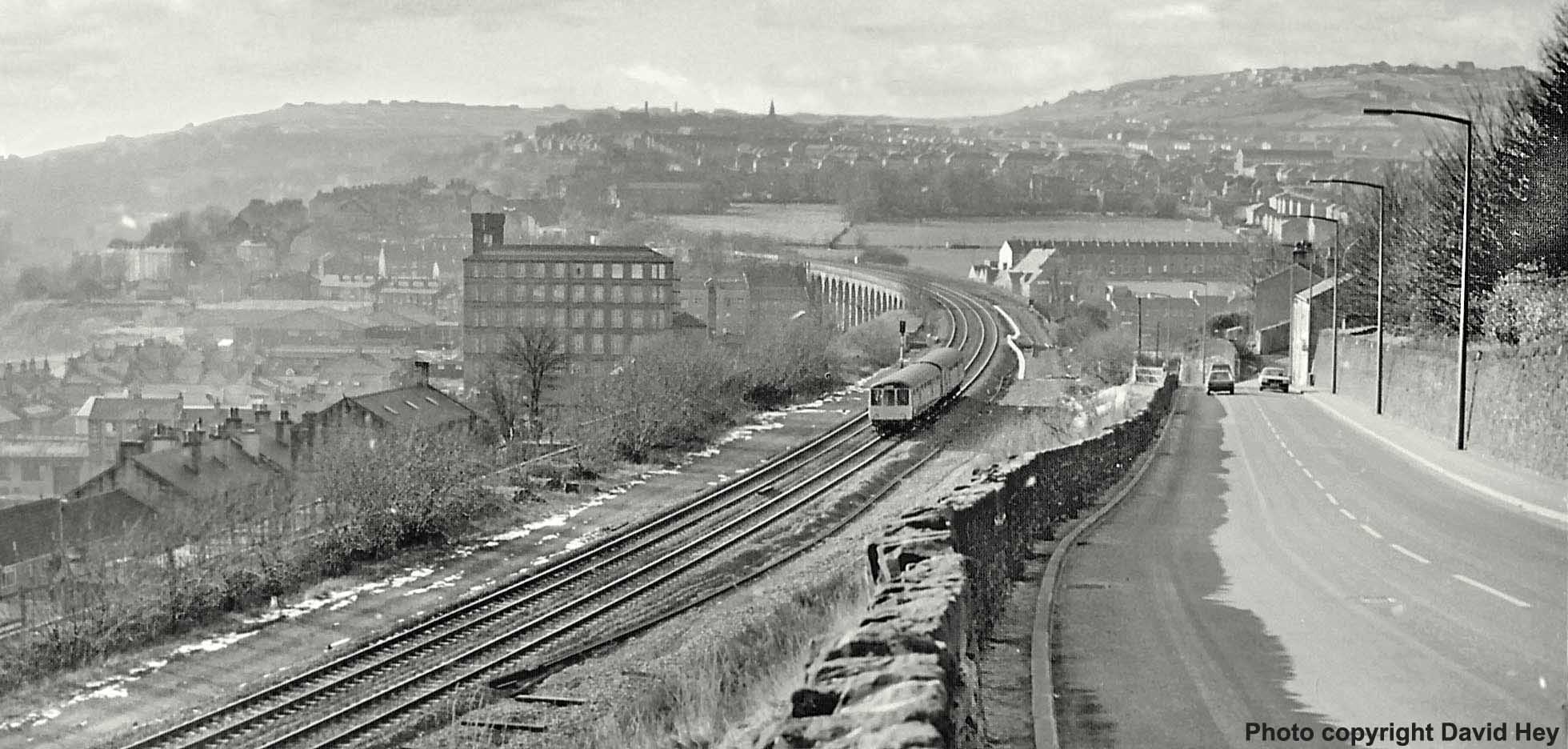
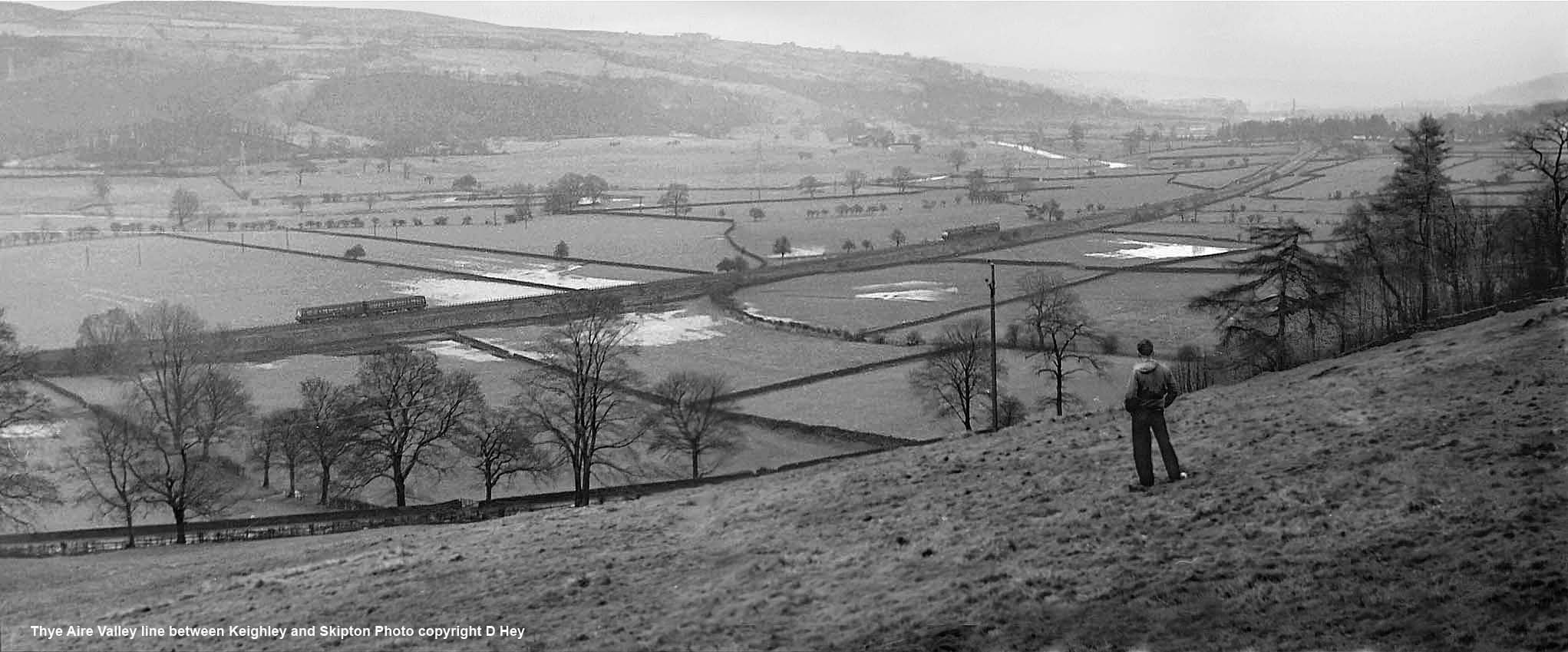
(Above-Below) Also there is the surrounding scenery to take into account as shown in this shot of a 2-car dmu running downhill on the Standedge line at Slaithwaite near Huddersfield, and the view (below) of the upper Aire Valley line at Steeton between Keighley and Skipton in the 1960s.
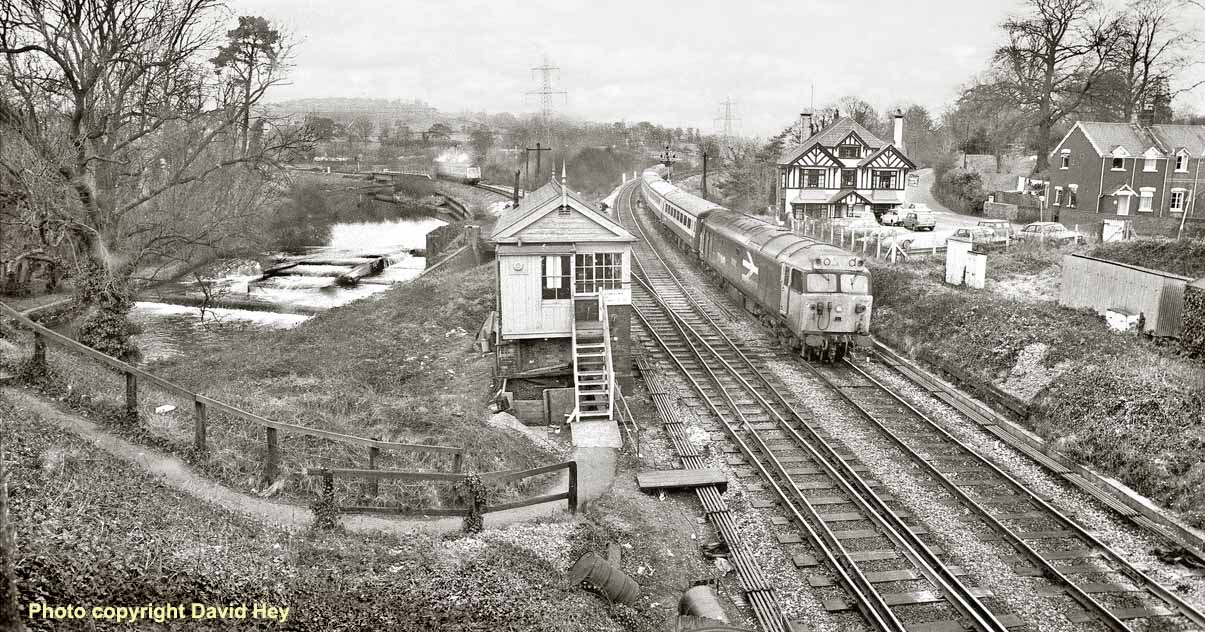
(Above) This image of a Class 50 (00-0-a-dh-50049-aller-jnct.jpg) is NOT Aller Junction near Newton Abbot (as I stated when first posted on the site). Maurice Clements kindly points out the error in his comments on the Guest Book Page; he writes - 'This image is in fact Cowley Bridge Junction, Exeter and not Aller Junction. The main line curving off to the right is the Exeter St Davids to Taunton line and the line off to the left is 'The Tarka Line' or Exeter to Barnstaple line. A brilliant website. Have enjoyed it for years…' Thanks Maurice...corrections are always welcome. The error came about because I posted this shot of Cowley Bridge Junction to replace an original posting of 50049 at Aller Junction and then I forgot to change the caption -doh!
RAILWAY ART GALLERY
I have recently been contacted by 76 year-old Alan Shillum, an ex-Daily Mirror reporter, news editor, finally managing editor, who since retirement on Mersea Island in Essex, has taken up art as a hobby in a variety of mediums and subjects.
This superb pencil drawing 'Good Companions' (below) was inspired by a Jim Carter photo that Alan found on this website. Measuring 18"x12" the drawing was done in 2b,3b,4b pencils on white picture mount card.
Harking back to his childhood days as a train spotter, Alan writes - 'I am still learning (art) and have a go at steam locomotives from time to time because to me they are aesthetically the perfect marriage of form and function. They are also a great challenge...'
....and very worthwhile, I must say...creative work takes a long time and a great deal of patience, but the results are very rewarding; indeed if anyone else is creating pictures of British trains and railways in oils, water colours, pen line, pencil or charcoal etc - I will be delighted to post them on this site for the whole world to see. My email address is at the bottom of the page...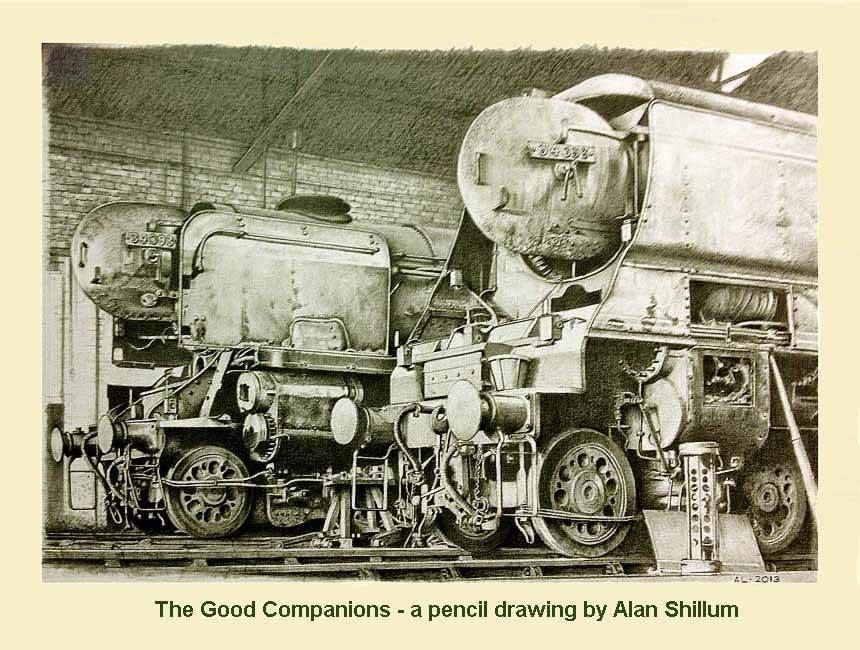
SOUTH AFRICAN STEAM by Craig Duncan
Born in Inverness, Scotland - and proud of his Scottish birth - Craig Duncan now lives in South Africa; he writes...
After inheriting a small box of oil paints in 1978 I began to dabble. I found the discipline of oil painting captivating and began to explore the techniques of composition, perspective, colour mixing, brush control, textures and so on. It was natural that my lifelong interest in railways would soon marry to this newfound medium of expression. Although my first painting was reasonably successful later critical analysis would reveal its flaws such as brush control being too tight etc. This painting now survives 6000 miles away in Earby, Yorkshire!
As paintings started to flow from the easel some seemed worthy of framing. Eventually I would have standing orders with wholesale framing suppliers from where the materials would be transported home, mitred in the workshop and then assembled on a table tennis top in the playroom; almost a home industry. The house soon became a personal art gallery and thankfully appreciated by my wife. In fact we developed a routine whereby she studied while I painted and the studio would reek of turpentine and pipe tobacco.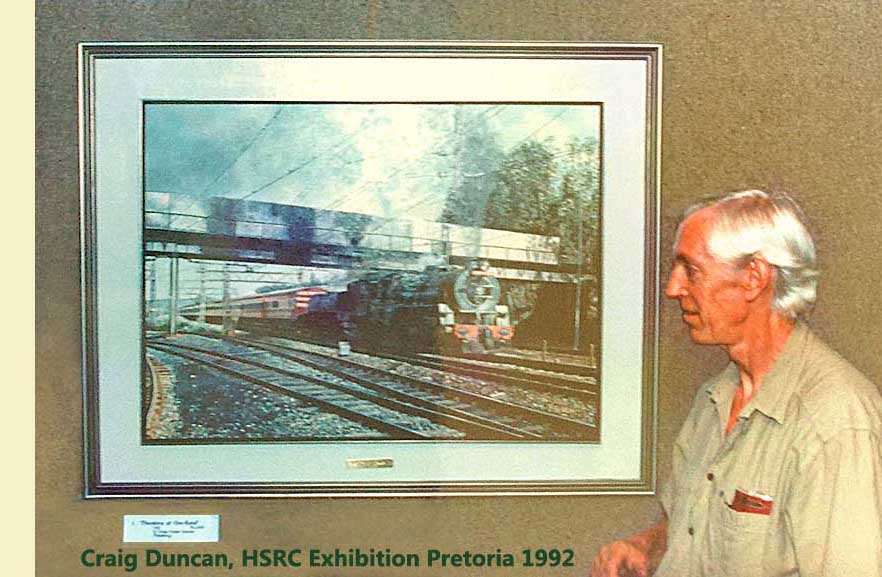 In mid-March 1991 I received a fax from a friend with an attached entry form for a forthcoming exhibition titled 'Brush with Steam' to be held at the prestigious Total Art Gallery in Johannesburg. A maximum of six paintings could be submitted from which selections, if any, would be made. Those dreaded words 'Curriculum Vitae' was also a condition. So these would all be professional artists but even worse it would be hosted by David Shepherd, someone who everybody had heard of; but only my wife had heard of Craig Duncan. With only a red face to be gained I plucked six paintings off the wall and, together with the required documentation, quickly dropped them off at the Transnet selection room haunted by those misgivings 'Am I out of my depth? 'and 'Is my framing up to exhibition standards?'
To my shock I was only one of two artists to have all six selected for showing, the other one being a well known TV personality renowned for his works. The exhibition was held June 4-18 1991 and there were 53 paintings on show representing 27 artists. On the opening night it was strange to see one's work hanging on alien walls and in exalted company; even appearing in a television programme which my wife would record.
The favourable media reports about my work was a great boost and so I decided to contact all exhibitors with a view to forming a society that would promote railway art in South Africa. I had a brief discussion with David Shepherd during a steam festival and exhibition at Kimberley in early August 1991 and on the 12th October an inaugural meeting was held.
After much help from the Guild of Railway Artists in the UK in drawing up a constitution we held our first general meeting on 29th February 1992 during which I was elected Chairman. And so the Guild of Railway Artists of Southern Africa was born. On 20th July 1992 we were granted affiliation to the GRA in the UK. We had 40 members and began to organize exhibitions in various parts of the country.
Amid all this on the 18th June my wife met a tragic death. For me this proved to be a completely demoralizing factor and with the impetus gone my brushes fell still and the Guild would fold as quickly as it had begun.
However a few years ago I decided to dust down the easel and add my own version to a couple of black and white photos. Surprisingly it all came flooding back and I found that I had produced two of my best ever 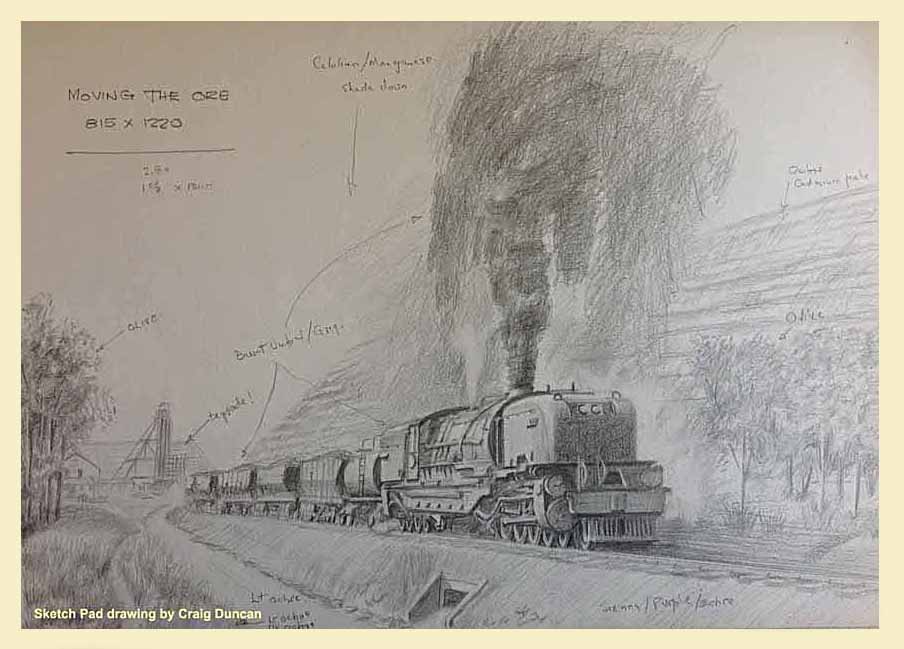 paintings, and in double quick time. It proved that a leopard never lose its spots.
Another lesson learned over time is that we are our own biggest critics and the perfect painting forever lies a bridge too far. Of some 50 paintings produced over the years 17 were commissions or sales. Belgian canvas was stretched on 20x45 mm mitred supports. Occasionally the canvas would require dampening to obtain a drum tight surface, but without a cropper and underpinner I found production of the outer frames somewhat time-consuming. Some of the recipients still express their pleasure which tends to suppress the inner demons that can lie within an artist...
(Above Left) The embryo stage for many of my paintings. I would sometimes uplift using a rule or sometimes a pantograph then sketch further detail on the canvas. All paintings have a canvas size of approximately 600 X 900mm.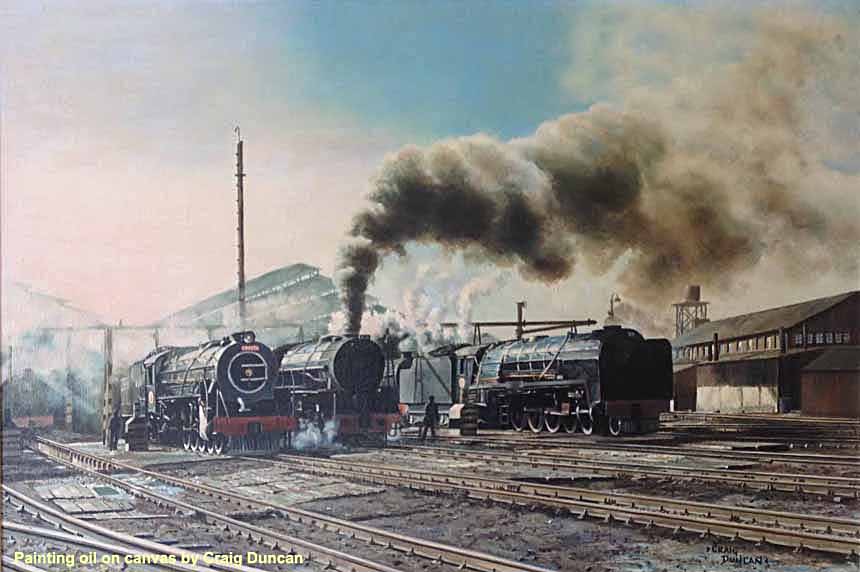
(Above-Below) Germinston Depot...many hours were spent at this location. I had a two-monthly renewable permit and have noted 200 steam locomotives during my Sunday visits there. The positioning of the pole was deliberate to cock a snoot at the purists. Most of my paintings bear an engraved brass plaque denoting the title. (Belw) These were the feeding troughs for the monsters. Coal trucks were taken up the incline and the contents emptied into hoppers from which chutes would discharge into waiting lines of engines on both sides of the dock.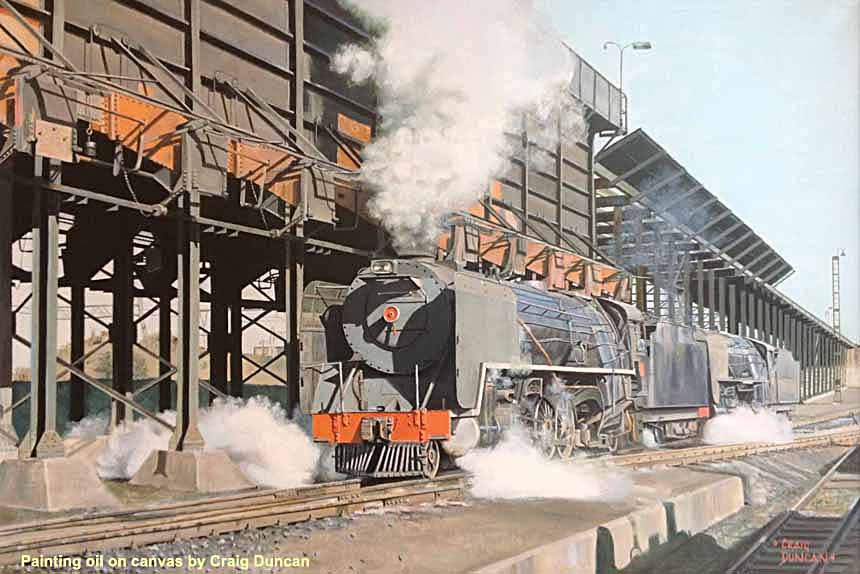
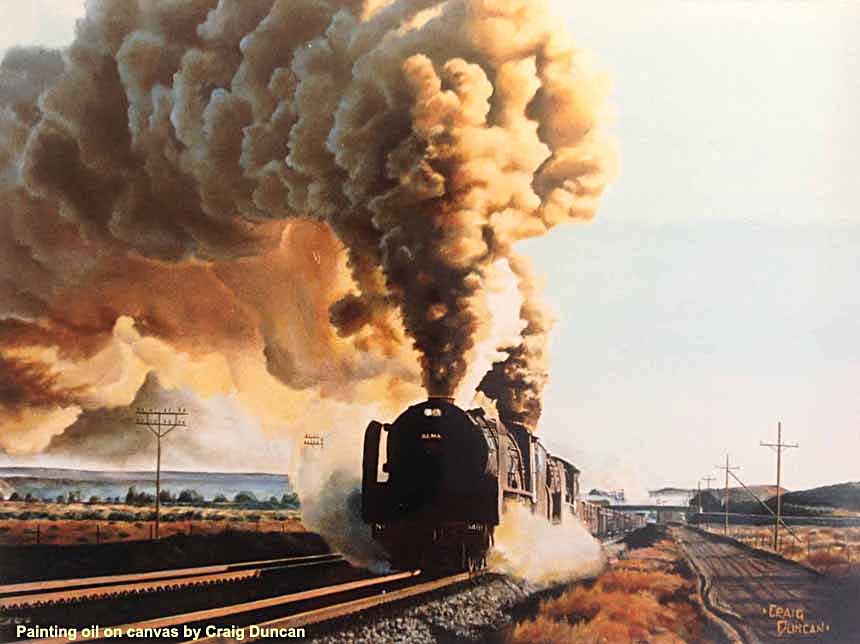
(Above-Below) Free State freight. Two 25NC's hit a straight line grade in the Free State. A trail of smoke could be seen from miles away and seemingly hang forever in the still and cold morning sky. (Below) A montage to pay tribute to the drivers and firemen who were the masters of their beasts. I have driven some, albeit for short distances, hence my admiration and esteem.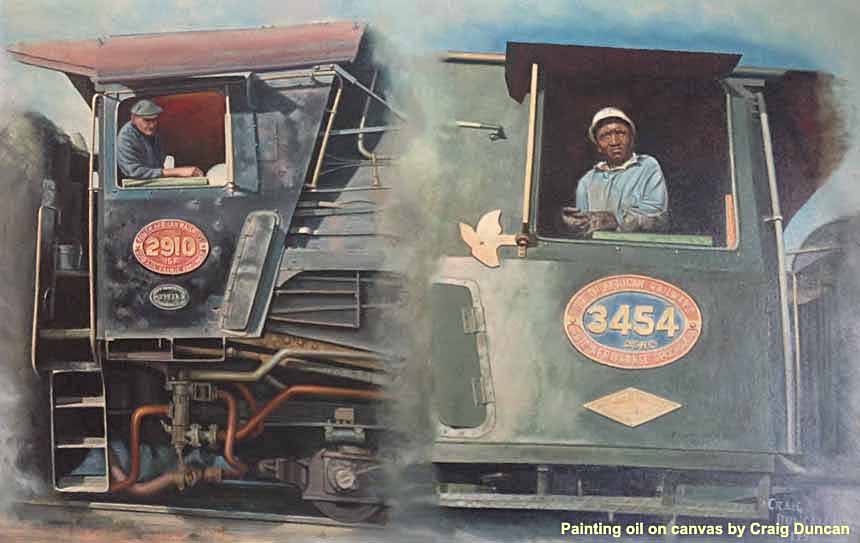
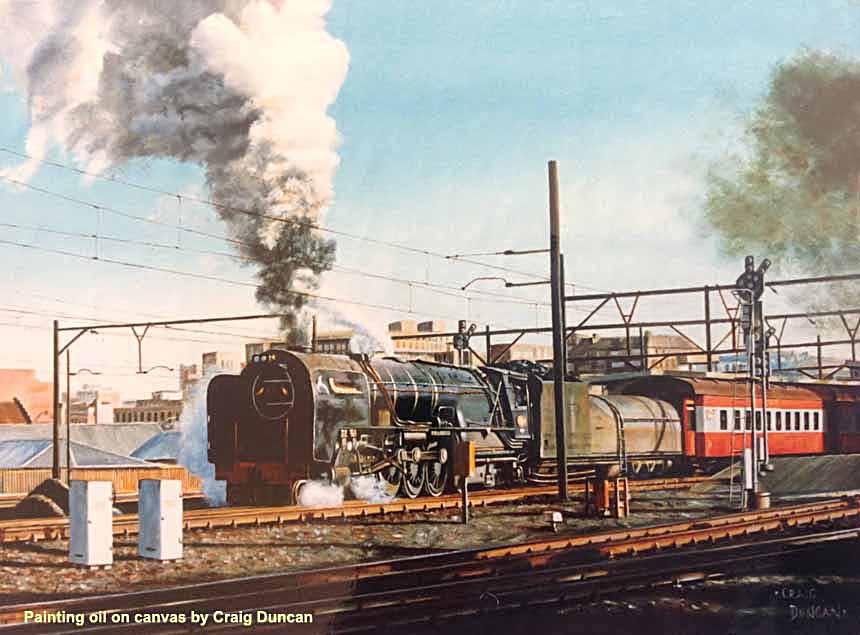
(Above-Below) This painting of a morning train leaving Bloemfontein met a sad end. It was damaged beyond repair when trying to remount it. So all I have is a photograph...sound familiar? (Below) 'Lady of the Loch' was the title on the engraved plaque added after I had framed it. Another gift to lifelong friends, it represents the pier end at Balloch, Loch Lomond and is a deviation from the normal railway subjects.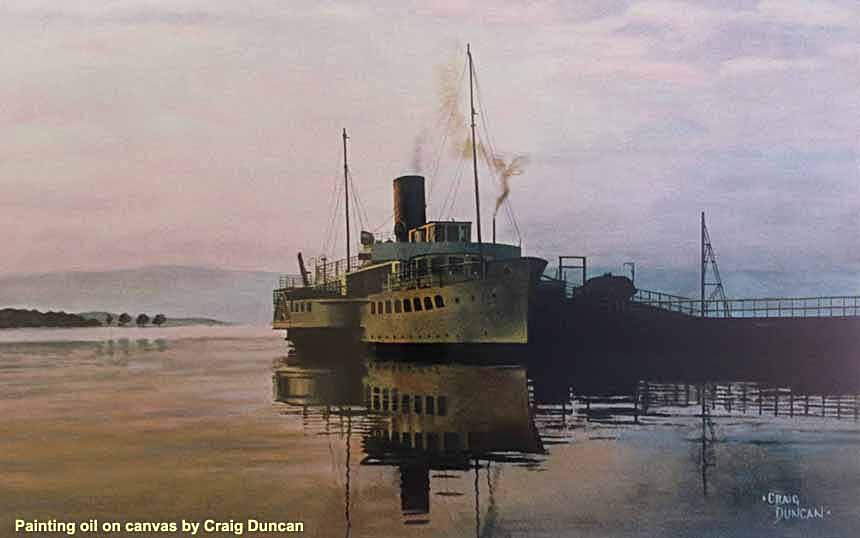
LIVERPOOL MEMORIES by Don Fogg
Don Fogg is another artist to make contact; he writes...
'Hi David, I have spent many happy nostalgic hours perusing your site, I was a train spotter from about 1958 at Edge Hill (8A) in Liverpool before moving to aviation in the Sixties but remain besotted by steam locos, ships and old aeroplanes. We have lived in Adelaide South Australia since 1983. I'm a teacher of Art and Special Ed. I enjoy the tantalising glimpses of your artwork - you should display more. I have been doing some pencil drawings of locos lately and have been using the web for reference. I am therefore asking you if you mind me using your pics as reference for my drawings. I'm not sure what I'll do with them but I have to get it out of my system (you probably know that feeling). I'm working on a fairly small format at present so I can scan them if you would like a look. I love the grimy Black 5s and workhorses (even Jinties) especially in tunnels or stations, very atmospheric. It takes me back to cycling from my home in Wavertree to Exchange station to see if the Glasgow arrival was hauled by a 'Brit'. I wish I'd had a camera! Happy Days! Keep up the fabulous work. Regards, Don Fogg...'
Well, true to his word Don has sent two drawings: 'Edge Hill Tunnels' and 'Sheds', both pencil with gouache highlights on tinted paper measuring 21cm square....
Thanks Don.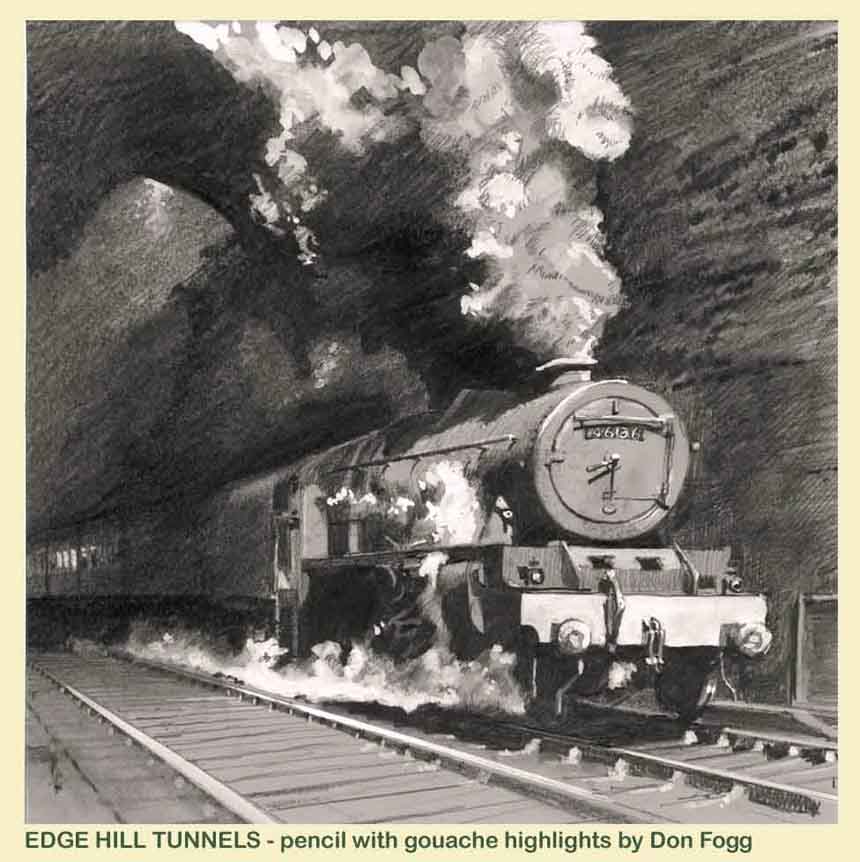
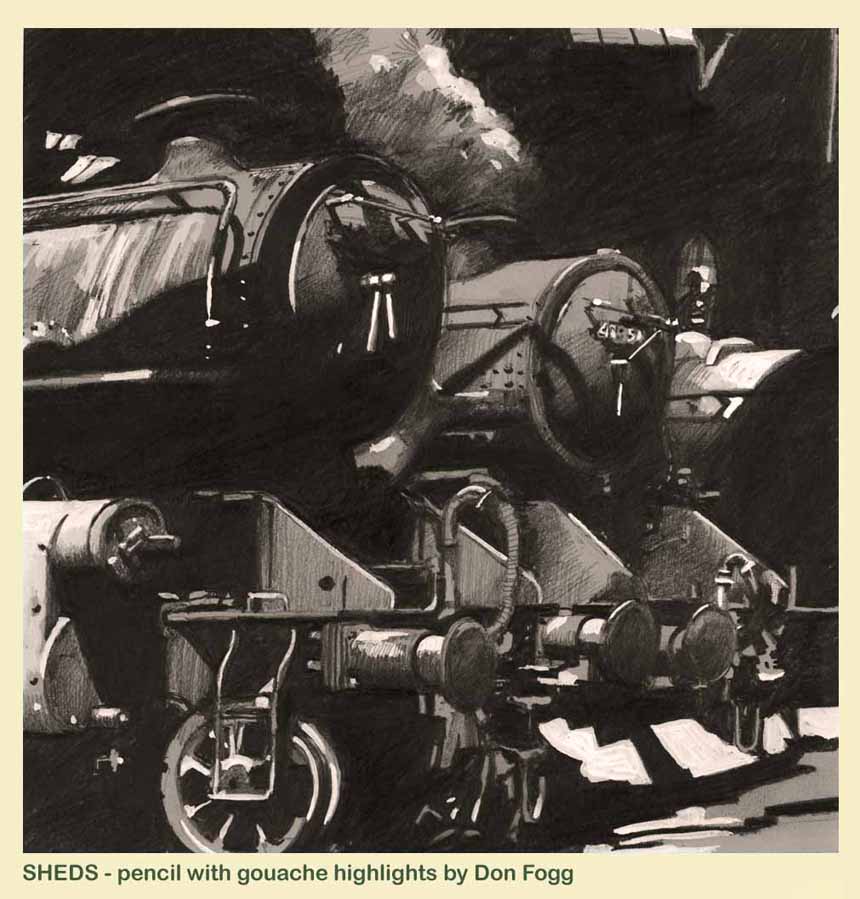
(Below) Here is a painting by artist James Green titled 'Black Fives - Willesden 1963' painted using an unusual mix of acrylic inks and watercolour. James wasn't born until the 1970s and so he wasn't around to see the day to day running of a busy steam shed, but I feel he has captured the overall atmosphere of the end of steam here perfectly. You can see more of James' railway paintings HERE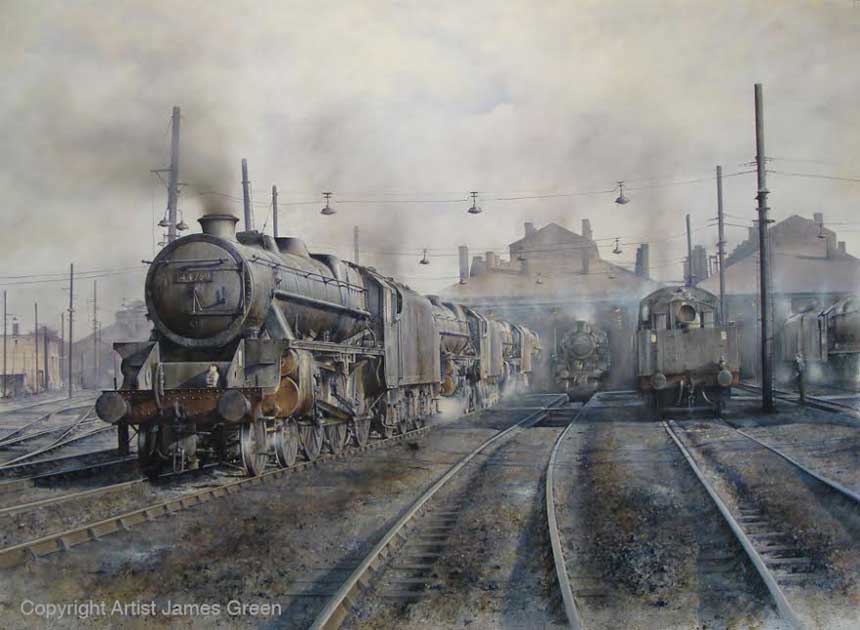
Are there any more artists out there?
I'll be pleased to post your railway art here...
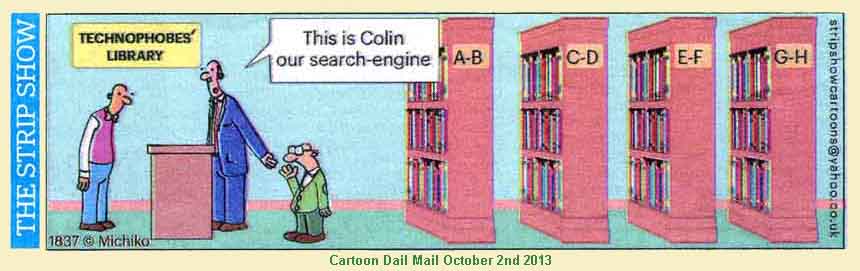
(Below) I do get one or two complaints from older visitors who've 'clicked-on' a page and find that it takes a long time to download.
The reason why some pages are slow is because of their huge size.
For example, if you 'click-on' a webpage containing text only it is much easier to load than a webpage of photos since it takes much longer to transmit. Many websites avoid this is by limiting the number of images. However, this website is primarily a collection of photographs and so what you are actually opening are pages full of images of steam days…
So please be patient!
Indeed if you like these pages then why not bookmark them? Or add them to your favourite list…I'm sure it will make your next visit a whole lot easier. Happy surfing!
SITE UPDATES!(Left-Below) Having recently acquired a new Negative Scanner I'm making a start on trying to resuscitate some 50 year-old negatives which have never been printed and are like ghosts from the past crying out to be exhumed (digitalized).  Over the years the 35mm negative strips have been kept in their original sleeves and are as good as new, though quite a few seem to have been 'got at' by a mysterious fungus,
 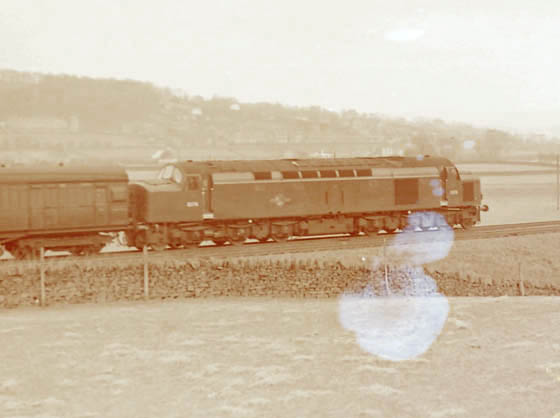 including this one of an unidentified EE Type 4 at Connonley between Skipton and Keighley in March 1961.
This image was taken just a few weeks before the introduction of Type 4 diesels on the Anglo-Scottish expresses north of Leeds; it records a brief period of our railway history therefore it must be worth saving if only for old time's sake. Back in the spring of 1961, BR introduced a crew training programme involving footplate staff at Leeds Holbeck and using 'Peak' class locos between Leeds and Appleby, but on occasions EE Co Type 4s were employed.
Now it has to be said that uploading an inferior photo onto the front page is hardly a ringing endorsement of the quality to be found on the rest of ther site, but it does illustrate the effort that goes into reviving old photos in a digital format (see Page 75 here) which otherwise wouldn't get a look in on the web. 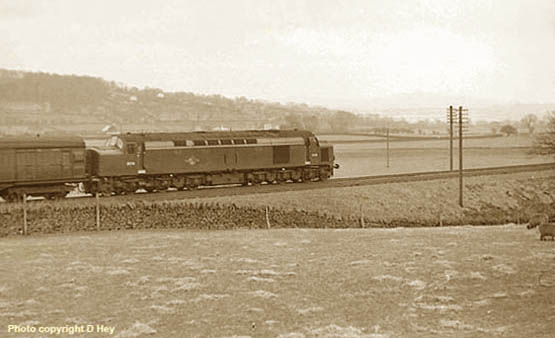
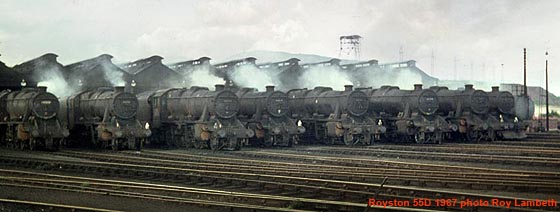
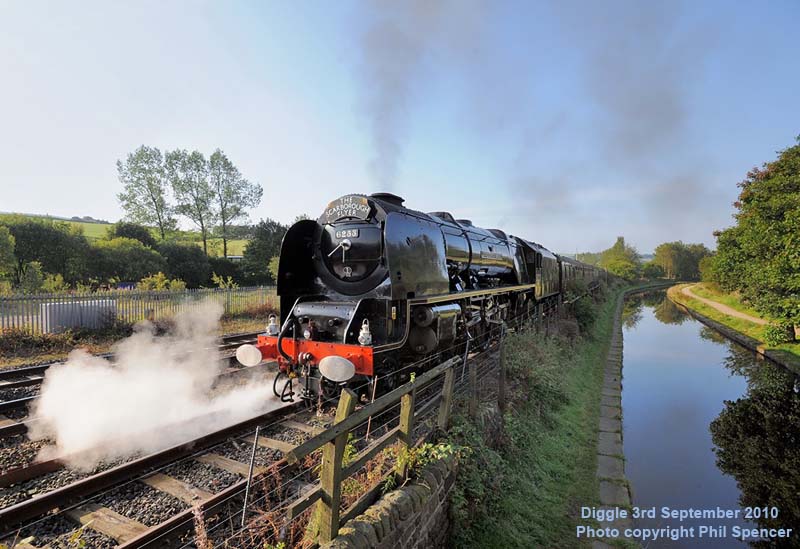
(Below) The marvel of the Internet! Whilst the World Wide Web allows you to wallow in unashamed  nostalgia for the old days, it also brings you bang up to date with current goings-on...for example (below) even before the Railway Touring Company's 07-12 Crewe-Scarborough (1Z64) 'Scarborough Flyer' had reached its destination on September 3rd 2010, pictures of the train were already winging their way around the world. In the midst of delightful Pennine scenery at Diggle, Phil Spencer captures the scene of No 6233 Duchess of Sutherland seeking refuge in the goods loop beside the Huddersfield Narrow Canal. The driver is awaiting the passage of a First TransPennine Express (FTPE) before rejoining the main line a few yards short of Standedge Tunnel.
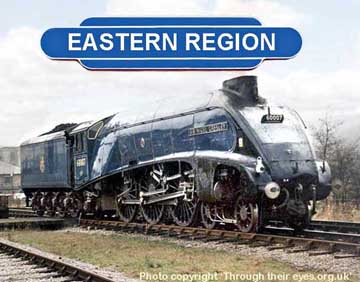
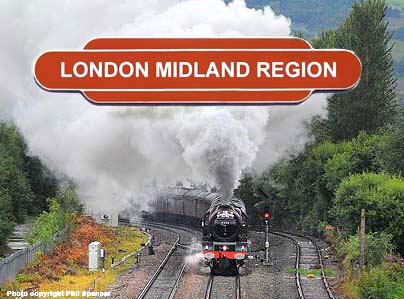
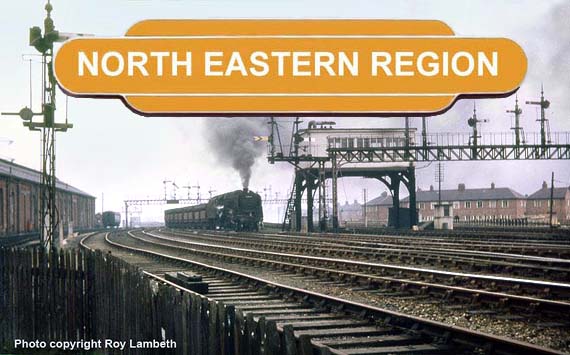
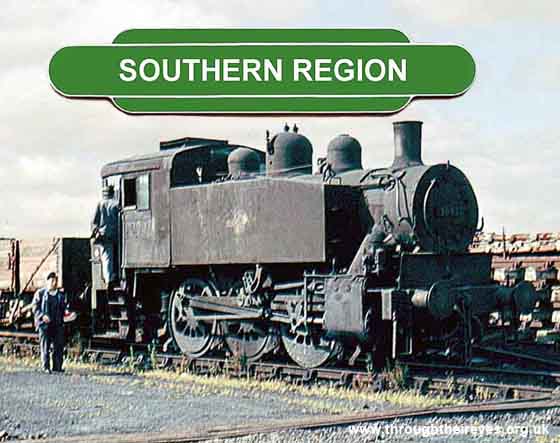
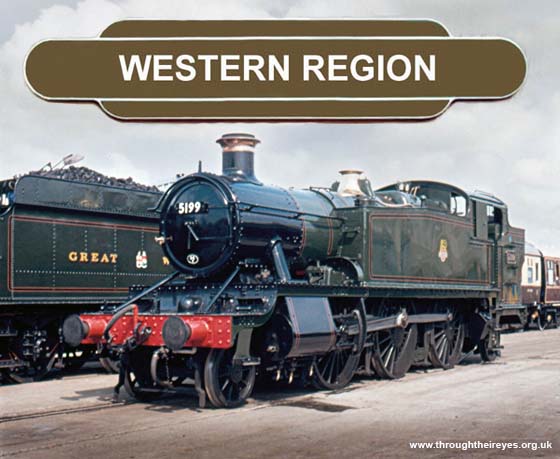
LINKS TO BRITISH RAILWAYS REGIONS
Click photos below to visit the relevant web page.
 |  |
 |  |
Click on photo-links (below) for NOSTALGIA FOR THE OLD DAYS
A Silver Surfer's trip down memory lane...
 |  |
 |  |
 |  |
THE FIRST GENERATION DIESELS
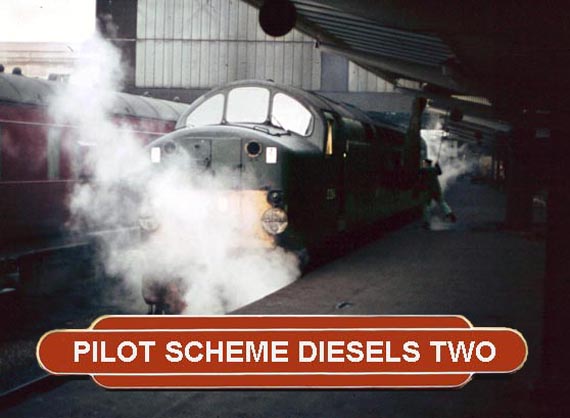
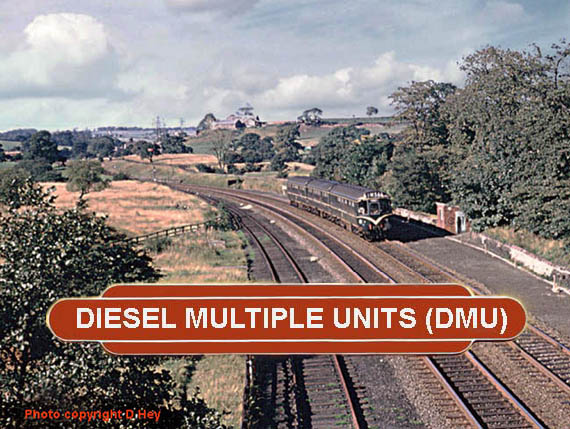
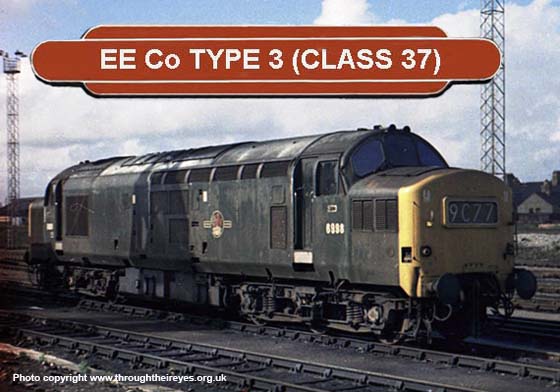
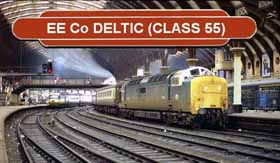
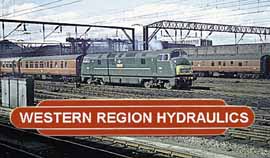
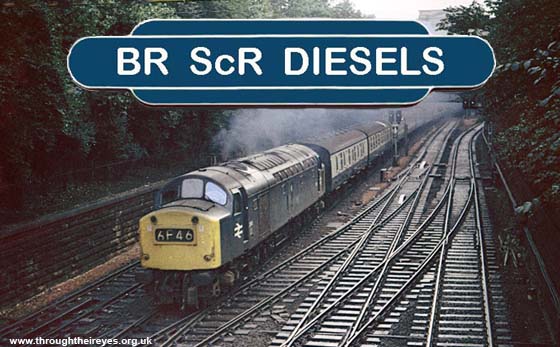
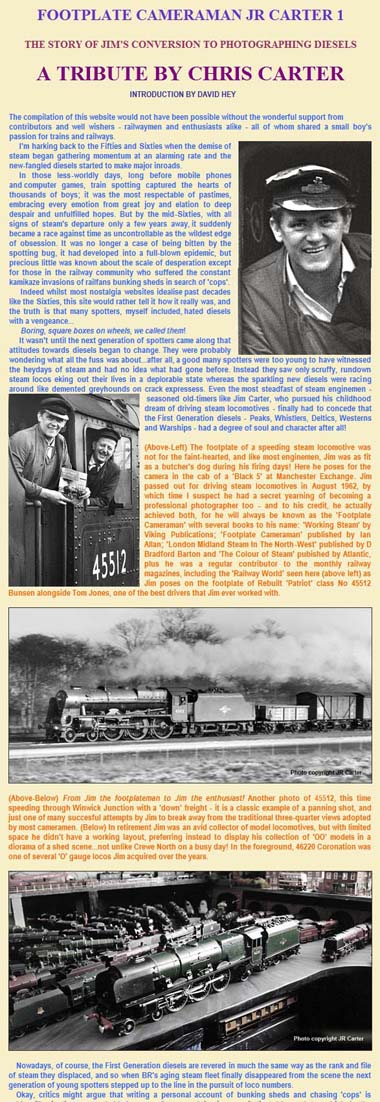
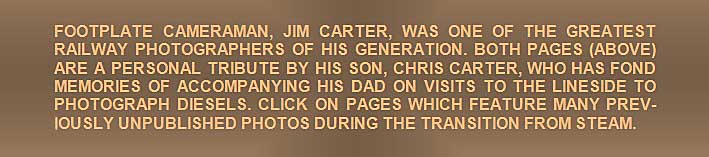
BR's Modernisation Plan didn't effect everyone. The 1960's spotting community was made up of countless thousands of youngsters, who, by virtue of their youth had no way of knowing what had gone before, so with the introduction of charismatic diesels like the 'Peaks', 'Deltics', 'Warships' and 'Westerns', the end of steam mattered little to them - and, if truth be told, even die-hard steam enthusiasts had to admire the performances of the new diesels. At the same time, BRs decision to name diesel locomotives was a commendable policy. The fitting of bodyside nameplates and, in some cases ornamental regimental crests, upheld a tradition going back donkey's years which added a certain panache to the new diesel fleet.
 |  |  |
 |  |
THE SECOND GENERATION DIESELS
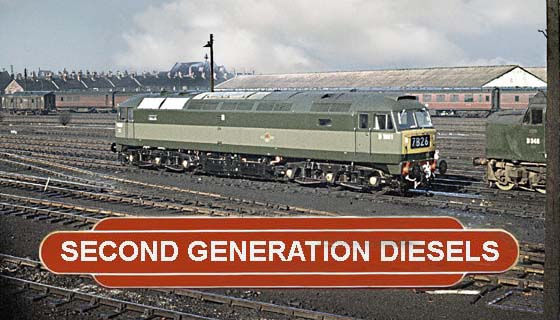
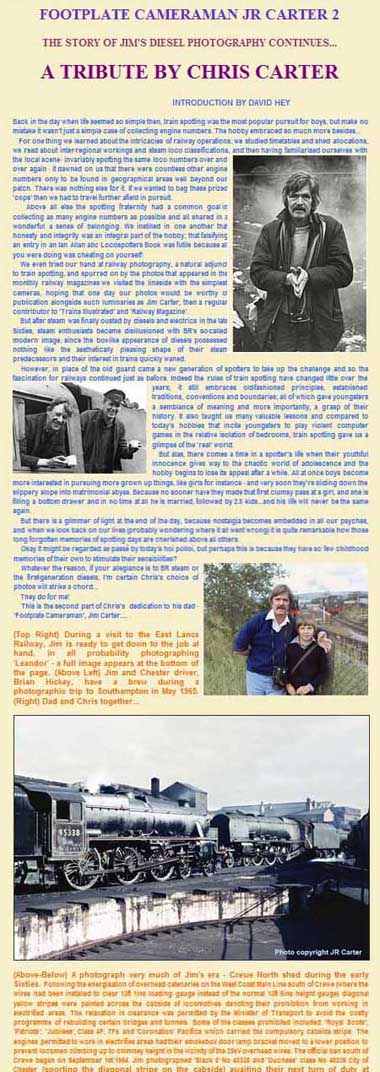
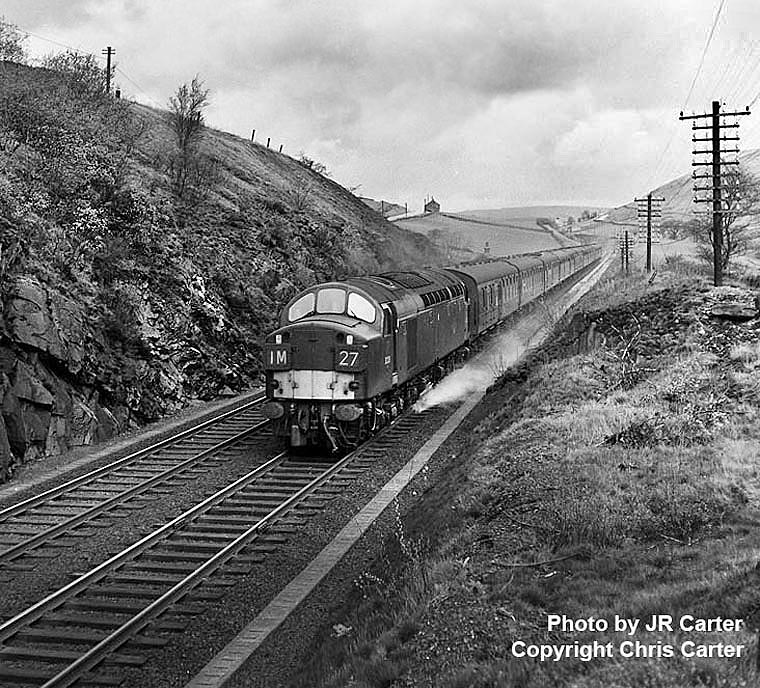
By 1965, BR's diesel fleet entered the much-maligned era of the 'Corporate Identity Programme' and the newly-formed British Rail Board (BRB) decreed that everything had to conform to a given standard. The BRB's design panel advised British Rail on the best means of attaining a high level of appearance by introducing a new livery for diesel and electric locomotives, passenger coaches, freightliner rolling stock and ships, along with the use of a new barbed wire logo, based upon the idea of two-way traffic movement. The diesel fleet's unimaginative colour scheme (devoid of a two-tone livery and bodyside lining) wasn't helped by the BRB's strict policy forbidding any concession to livery changes, which deprived depot staff of any incentive to take a pride in their particular traction, and it wasn't until the late 1980's that the BRB finally adopted a more enlightening approach for its newly-launched Regional Services and Sectors.
AROUND THE REGIONS - STEAM DAYS
 |  |  |
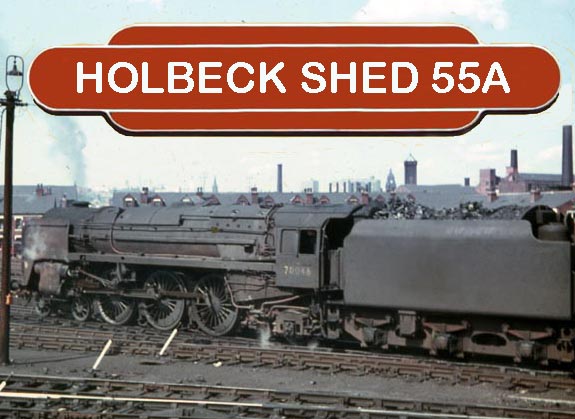
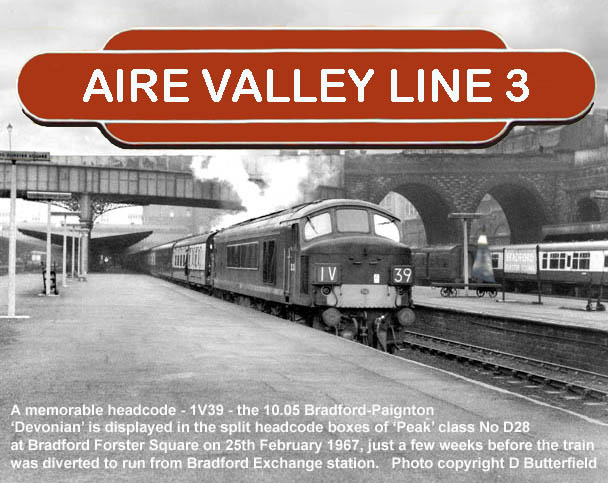
 |  |
 |  |
 |  |
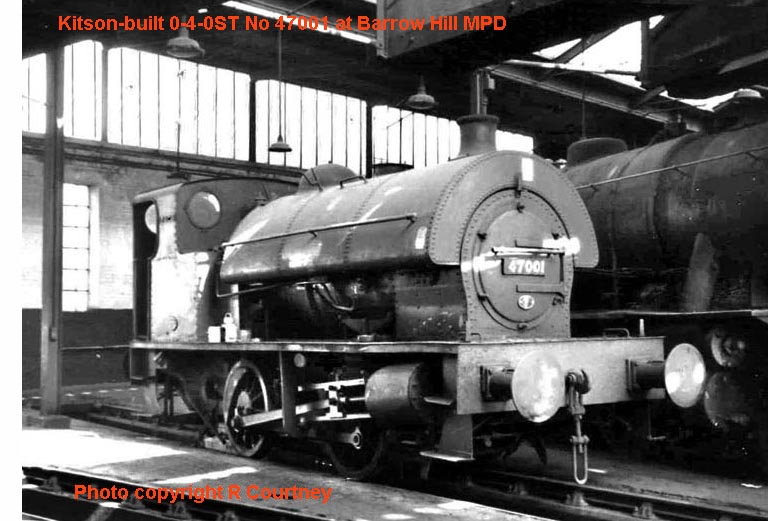 LOST AND FOUND! This site receives a lot of requests for photos and enquiries from visitors seeking information on trains and railway, but since I can't deal with them all myself I've launched a new 'Help' facility to help broaden your own search to a worldwide audience. Over the years, more and more visitors to this site are using the 'Guest Book' page in their search for information, and I am happy to oblige. If you are seeking assistance in your own search then visit the Guest Book page, but please include your email address in the message and deal with it yourself. I am not in the business of brokering any deals, nor am I an Estate Agent...some wag recently posted a house for sale - cheeky! But the facility has produced a result! Regular visitors to this site might recall Adam Parker contacting the Guest Book Page seeking information on a number of railway photos that he unwittingly became the custodian of. In fact, had it not been for Adam taking them under his wing the whole lot would have ended up on a bonfire! It was a most interesting story, and one I was happy to feature on the 'BR London Midland Region' page. Click here for linkto 'Adam Parker's Album of Found Photos'. Since the appeal went out on the LMR page Adam has been contacted by the photographer, Richard Courtney and the material has been returned to the rightful owner...the wonder of the Internet - and ten out of ten to Adam for successfully tracking Richard down. It reaffirms one's faith in human nature...
Being a relatively newcomer to the web (better late than never, they say) the whole point of the collection is  to try and build the best website possible and give something back to the community. At the same time I was keen to learn something about digitally enhancing old photos, such as 'burning' and 'dodging', sharpening, improving brightness and contrast, and removing spots or other unsightly blemishes. I began by practising in Adobe Photoshop; a powerful graphics tool that is used by cutting-edge designers who work at the sharp point in a studio, but since I have only modest ability, it is more like a computer darkroom that contains all the tools needed to work on old photographs - and, rather like a small boy rummaging in a toy cupboard, it allows me to zoom-in to a single pixel. I'm bound to get up close and personal with all photographers' work!
If you would like to contribute to the website I'll be pleased to include your spotting reminiscences from steam days, but be warned - the seasoned spotter can spot a 'porky' a mile off, so embellishing your story  with fictional flourishes is hardly convincing.
That's because train spotting captured the hearts of thousands of boys during the less-worldly Fifties, and although most of us are well past our prime (and forgotten what we did two minutes ago) the ageing process is surprisingly kind in another way. In the glow of memory we only remember the good stuff, so our spotting memories are bound to be mired in sentimentality.
On the other hand, critics would argue that writing a personal account of 'bunking' sheds and chasing 'cops' is seldom illuminating or remarkable because all you are doing is regurgitating old anecdotes, which, by the very nature of the hobby, are exactly the same as everyone else's...RUBBISH! Call me an old-fashioned day dreamer, but any memory of bygone days is better than none. Just send me a favourite old photo accompanied by a meaningful caption and it will give visitors to this site a chance of escaping the grim reality of today's modern world...
 |  |
DEDICATION On a final note, the most popular idols back in the Fifties were the comic 'cape crusaders' Spiderman, Batman or Superman, together with the Hollywood cowboy stars: Hopalong Cassidy, Gene Autry, Roy Rogers and the Lone Ranger.
|
PLEASE NOTE - IMAGES FROM THIS SITE SHOULD NOT BE PUBLISHED ELSEWHERE ON THE WEB WITHOUT THE PRIOR CONSENT OF THE RIGHTFUL COPYRIGHT OWNERS. IF YOU WISH TO USE A PICTURE ON THE WEB THEN YOU MUST ASK FIRST. A GOOD FIRST STEP IS TO MAKE CONTACT VIA THE E-MAIL ADDRESS AT THE BOTTOM OF THIS PAGE. YOU ONLY HAVE TO ASK...PERMISSION IS RARELY REFUSED, A RECIPROCAL LINK TO THIS SITE IS USUALLY THE CASE.
All text and photographs are protected by copyright and reproduction is prohibited without permission from the © owners. If you wish to discuss the contents of this site the email address is below. Please note - this is not a 'clickable' mail-to link via Outlook Express; you will have to mail manually.
dheycollection@ntlworld.com